



What Is Growth Marketing? The Honest 2026 Guide
August 24, 2026
In-House vs Agency vs Fractional CMO: The Honest, Ultimate Guide
August 28, 2026
Traffic But No Sales? Here’s What’s Actually Broken
Your analytics dashboard looks fine. Sessions are climbing, the blog is getting shares, maybe an ad campaign is driving real volume. None of it is turning into revenue, and you are running out of explanations that do not sound like excuses.
Having traffic but no sales is not usually a marketing volume problem. It is a mismatch problem, and the mismatch can live in several different places between the click and the purchase.
The Traffic Number Is Not the Problem
The instinct when sales stall is to drive more traffic. More ads, more posts, more outreach. If the underlying issue is a mismatch rather than a volume shortage, more traffic just means more people hitting the same broken step, faster.
Unbounce’s 2024 Conversion Benchmark Report, built from more than 57 million conversions across 41,000 landing pages, puts the median conversion rate across industries at 6.6 percent. If your traffic is real and your conversion rate sits well below that, the gap is rarely explained by “not enough people are visiting.” Something between the visit and the purchase is not doing its job.
Where the Leak Usually Is
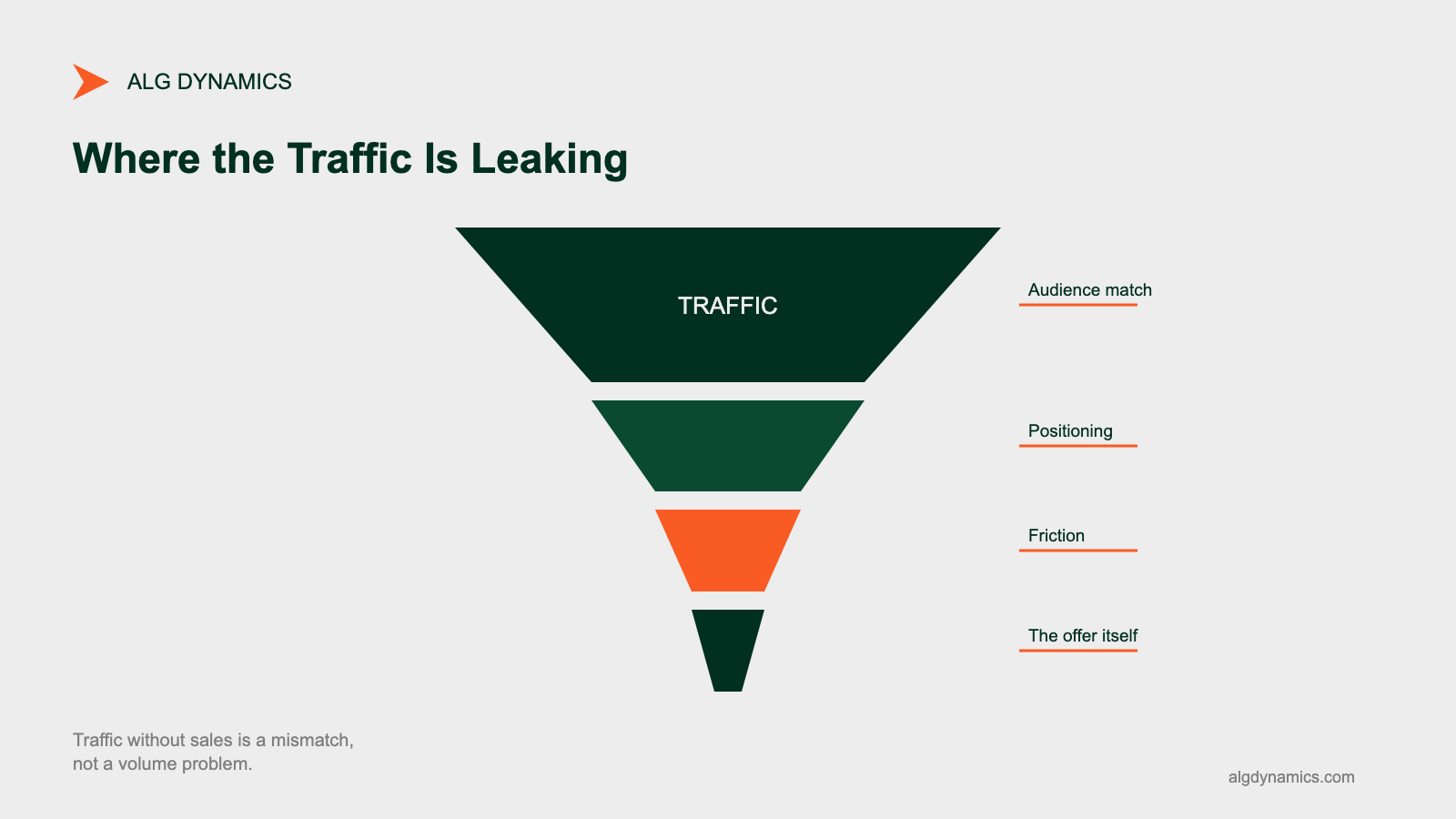
Four places account for most cases of traffic without sales, and they sit in a rough order of how often each one turns out to be the actual cause.
| Rank | The Leak | What It Looks Like |
|---|---|---|
| 1 | Message-to-audience mismatch | Traffic is real, but made of the wrong people: browsers instead of buyers, or buyers expecting something your offer doesn’t deliver. Shows up as high bounce rates and short time on page. |
| 2 | Unclear positioning | Visitors understand roughly what you sell but not why to choose you over the other tabs they have open. Vague, average-sounding claims lose to specific ones every time. |
| 3 | Friction in the path to purchase | A confusing checkout, a form with too many fields, a price that’s hidden until the last step. Most visitors don’t complain about friction. They just leave. |
| 4 | A genuine offer problem | The product is priced wrong, positioned for the wrong stage, or simply isn’t what the traffic source implied. Least common, and the one businesses are most reluctant to consider, since the fix isn’t a landing-page tweak. |
When the Traffic Itself Isn’t Real
Before diagnosing message match or friction, rule out a simpler explanation: some of the traffic in your dashboard may not represent real prospects at all. Bot traffic, misconfigured tracking that double-counts sessions, or a spike from an unrelated viral post can all inflate the number without adding a single qualified visitor.
This is a quick check, not a deep one. Look at session duration and pages per visit for the traffic spike in question. Real prospective buyers tend to look at more than one page and stay longer than a few seconds. A spike made mostly of sub-five-second sessions is not a sales problem. It is a measurement problem, and it is worth ruling out before the rest of the diagnosis starts.
Why Traffic But No Sales Is Hard to Diagnose Alone
Each of these problems produces the same symptom from the outside: traffic but no sales. Distinguishing between them requires looking at behavior, not just totals, because a business owner staring at a traffic number has no way to see which cause is actually at fault.
This is the same trap that shows up in the growth marketing conversation more broadly. Testing a headline does nothing if the real issue is that the wrong audience is reading it. Fixing checkout friction does nothing if visitors were never going to buy in the first place. Diagnosis has to come before any of these fixes are worth attempting, and guessing at which one applies usually burns a quarter before the real cause gets addressed.
Run a Marketing Clarity Intensive →
What an Actual Diagnosis Looks Like
A proper diagnosis starts by separating traffic quality from traffic quantity. Where is the traffic coming from, and does that source actually attract people who want what you sell. It then traces behavior past the click: where visitors stop scrolling, where they abandon a form, what they click right before leaving.
From there, the pattern behind traffic but no sales usually points to one or two of the four causes above, not all of them at once. Fixing a positioning problem when the real issue is audience mismatch wastes the same quarter as fixing nothing. The content marketing audit approach we use follows this same order: understand where the traffic actually comes from and what it expects before touching a single page.
FAQs
How do I know if it’s a traffic quality problem or a website problem?
Compare behavior by source. If traffic from one channel converts reasonably well and another converts near zero, the issue is likely audience mismatch on the weak channel, not a broken website. If every source converts poorly, look at the page and the offer.
What conversion rate should I actually expect?
It depends heavily on industry and traffic source, but the widely cited median across industries sits around 6.6 percent for landing pages. Treat industry-specific benchmarks as a rough compass, not a target, since your traffic mix and offer type shift the number in either direction.
Could this just be a slow season?
It’s possible, and worth ruling out with a quick look at the same period last year. But “slow season” is also the most common explanation businesses reach for before doing the harder work of checking message match and funnel friction, so rule it out with data rather than assuming it.
Is the fix always a website redesign?
Rarely. Most traffic-without-sales problems trace back to message mismatch or unclear positioning, which is a messaging and targeting fix, not a redesign. A full redesign is usually the most expensive way to solve a problem that a clearer value proposition would have fixed for less.