

Fractional CMO Cost in 2026: Real Pricing, Hidden Fees, and What You Actually Get
August 21, 2026
Traffic But No Sales? Here’s What’s Actually Broken
August 26, 2026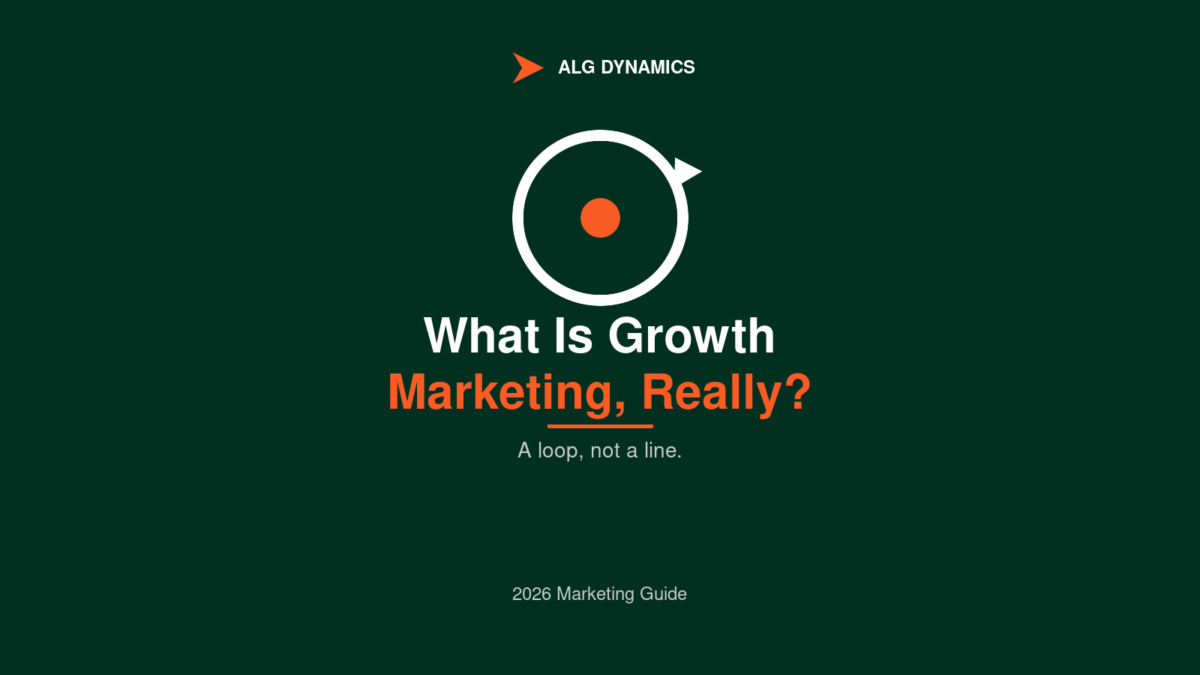
What Is Growth Marketing? The Honest 2026 Guide
You are running paid ads, posting several times a week, and sending a monthly newsletter. Someone called this “legacy marketing” and told you that growth marketing is the real answer. You are not sure if that is a meaningful distinction or a rebrand with a bigger price tag.
The confusion is reasonable. Growth marketing and traditional marketing use the same channels: ads, email, content, social. The difference is not in the tools. It is in what each approach is built to measure, test, and compound over time.
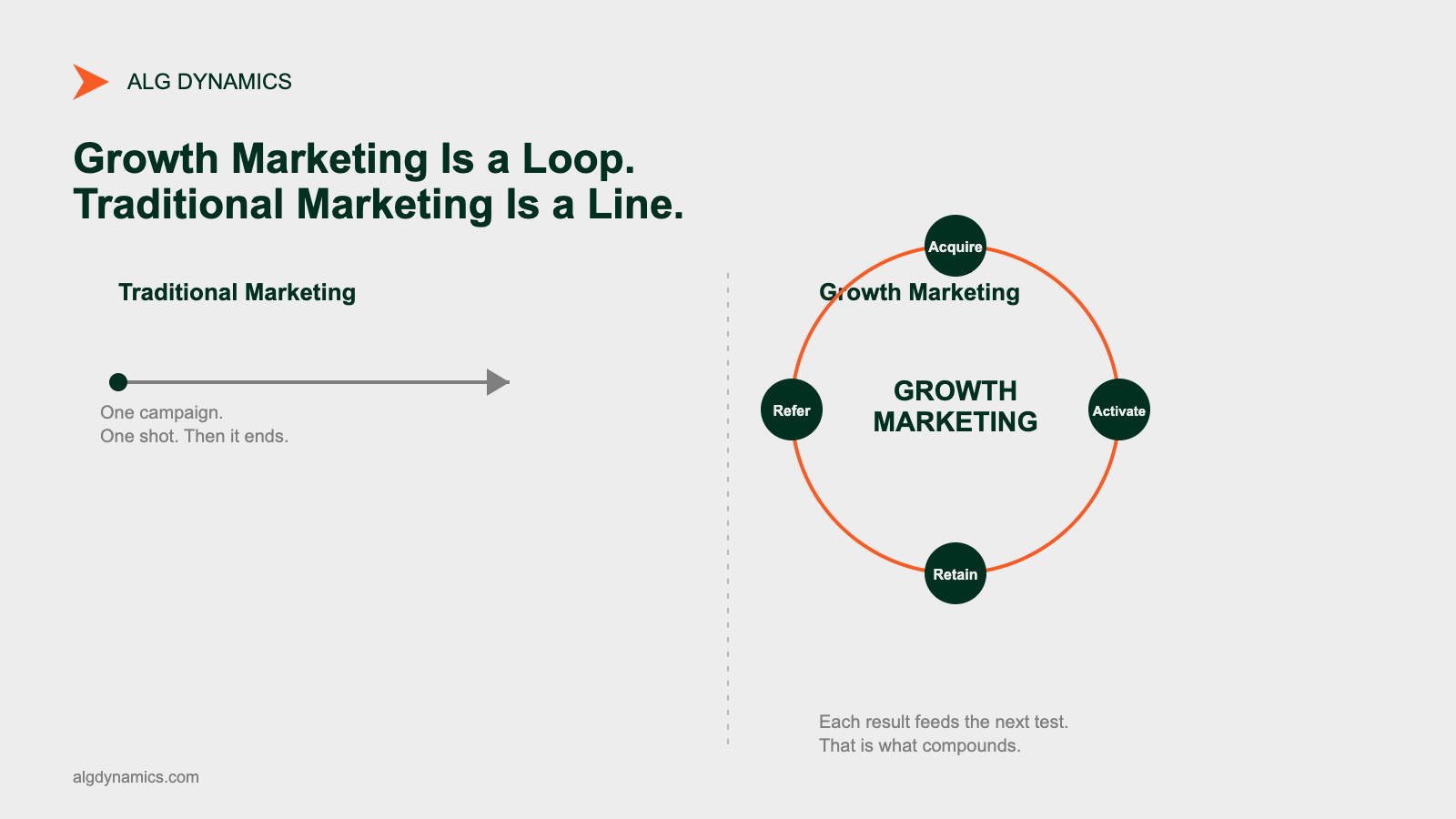
Marketing That Runs vs. Marketing That Compounds
Most small business marketing is organized around a calendar. A campaign launches, runs for a set period, and gets replaced by the next one. Success is usually measured by reach, engagement, or whether the campaign “felt” like it worked, because there is rarely a clean way to trace a specific post back to a specific sale.
HubSpot describes growth marketing as the practice of running small, structured experiments that extend across the full customer lifecycle, from acquisition through activation, retention, and referral, rather than stopping at awareness. That full-funnel scope is the real dividing line. Traditional marketing optimizes for attention. Growth marketing optimizes for what happens after someone pays attention.
This is not a value judgment about the marketing you are already doing. Ads, content, and email are the same raw materials either way. What growth marketing changes is the operating model wrapped around them: a working hypothesis, a way to measure whether it held, and a next test that builds on what the last one taught you.
Four Ways the Two Approaches Actually Differ
The label matters less than the mechanics underneath it. Four differences separate a growth marketing system from a series of marketing activities.
Traditional marketing measures impressions, reach, and brand lift. Growth marketing measures activation rate, customer acquisition cost, and lifetime value, because those numbers connect directly to revenue instead of attention. Traditional marketing concentrates budget and creative energy at the top of the funnel, on the assumption that enough awareness eventually turns into sales. Growth marketing spreads attention across the whole funnel, on the assumption that a leak anywhere between click and repeat purchase is worth fixing before spending more to fill the top.
Traditional marketing plans campaigns around a content calendar. Growth marketing plans experiments around a hypothesis, tests it against a control, and only scales what the data supports. Traditional marketing treats each campaign as a fresh start. Growth marketing treats each result as an input to the next test, which is the actual source of the “compounding” that gets talked about so often and demonstrated so rarely.
Signs You’re Already Closer Than You Think
A few signals suggest your current marketing is closer to a growth system than you might assume, and a few suggest it is still built around activity alone.
You are probably closer to growth marketing already if you can name your customer acquisition cost by channel, if you have changed a campaign mid-flight because of what the data showed rather than waiting for it to finish, or if you can point to what happens to a customer after their first purchase and not just before it.
You are probably still in activity mode if your reporting stops at clicks or impressions, if every campaign starts from a blank page instead of what the last one taught you, or if “it’s doing fine” is the most specific answer you can give about performance.
Neither list is a verdict. It is a starting point for the diagnosis that has to happen before any testing loop is worth building.
Why Adding “Growth” to Your Marketing Rarely Works
Here is the part most explanations of growth marketing skip. You cannot bolt a testing loop onto marketing that has no underlying diagnosis. A/B testing headlines on a landing page does nothing if the page is aimed at the wrong audience in the first place. Optimizing an email sequence does nothing if the offer inside it does not match what your customers actually want to buy.
Growth marketing without a diagnosis is just faster guessing. This is why activity and system are not the same thing, and why so many businesses run growth marketing tactics without ever getting growth marketing results. The testing loop only compounds when it is pointed at a problem that has already been correctly identified: the right audience, the right positioning, the right stage of the funnel.
That diagnostic layer is what separates a business that tests its way to real gains from one that tests its way to a slightly different flavor of the same plateau. ALG Dynamics’ growth marketing consulting starts there deliberately, identifying what is actually preventing growth before recommending which experiments are worth running.
What to Do Before You Start Testing
If you are already running ads, content, and email, you do not need to throw any of it out to adopt a growth marketing approach. You need three things layered underneath it: a clear picture of who you are actually trying to reach, a funnel that is measured end to end instead of just at the click, and a habit of treating each campaign as a test rather than a one-off.
The order matters. Diagnosis before prescription, structure before scale. Skipping the first step and jumping straight to tactics is the most common reason growth marketing efforts stall before they compound into anything.
See the Marketing Clarity Intensive →
FAQs
Is growth marketing just a rebrand of digital marketing?
No. Digital marketing describes the channels: ads, email, social, SEO. Growth marketing describes the operating model layered on top of those channels: full-funnel measurement, hypothesis-driven testing, and results that compound instead of resetting with each campaign.
Do I need a growth marketing team to start?
No. A single person, even a founder, can run a growth marketing approach with the right structure underneath it: a clear audience, a funnel that is measured past the click, and a habit of testing rather than guessing.
How long before growth marketing shows results?
It depends on what has to be diagnosed first. A business with a clear audience and positioning can start testing within weeks. A business without either usually needs that clarity established before any test is worth running, which is a separate, shorter step.
What’s the difference between growth marketing and growth hacking?
Growth hacking usually implies a narrow focus on rapid, often unconventional acquisition tactics. Growth marketing is broader and more structural: it spans the full customer lifecycle and treats testing as a permanent operating habit, not a short-term hack.
The Real Question to Ask
The question “is this growth marketing or traditional marketing” is less useful than “do I know what is actually holding growth back, or am I running activity and hoping it adds up.” Most businesses can answer the first question. Fewer can answer the second with any real confidence.
That gap, not the label on your marketing, is what decides whether your next campaign compounds into something bigger or resets you back to zero.