


AI Literacy for Non-Technical Professionals: What It Is and Why It Matters
October 14, 2026
AI Agents for Small Businesses: What They Do and When They Are Worth It
October 19, 2026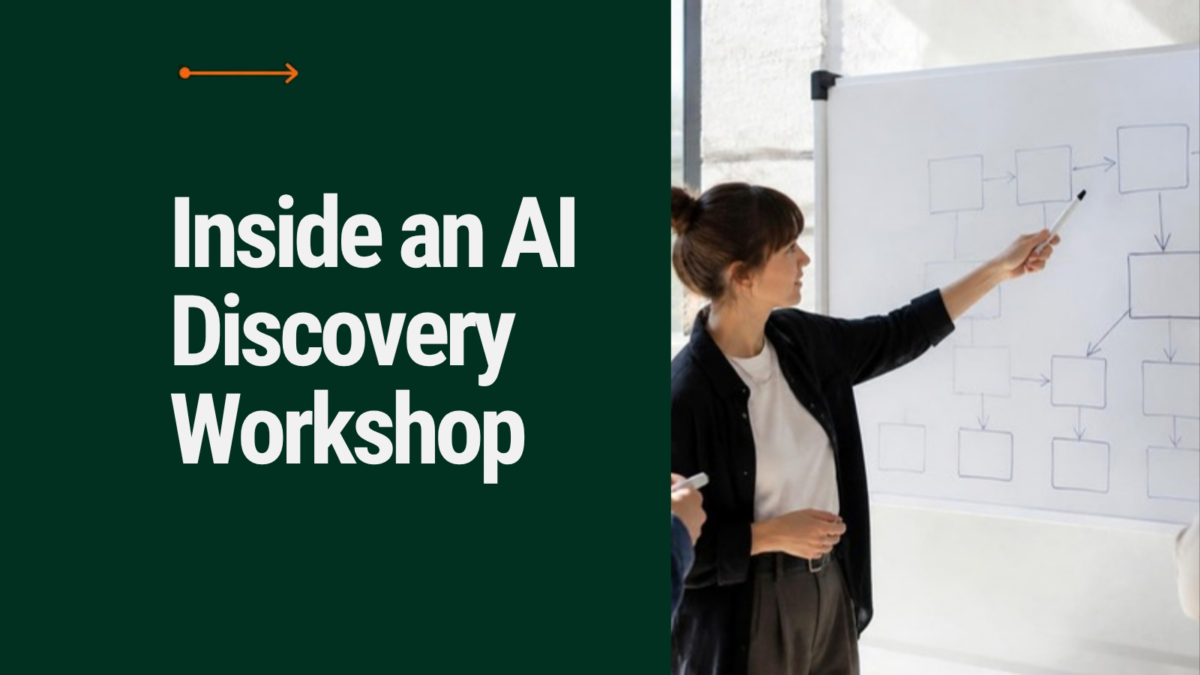
AI Discovery Workshop: What It Is and What a Small Business Should Get From One
An AI discovery workshop is a structured session, usually a few hours to a few days, in which a business maps its real workflows, identifies where AI could help, and ranks those opportunities by value and feasibility before buying tools or building anything. The main output is a short, prioritized list of AI use cases with a clear first step. For a small business, a good discovery workshop replaces scattered experimentation with a decision.
The format exists because most businesses approach AI backwards. They start with a tool someone recommended and look for problems it might solve. A discovery workshop reverses that order. It starts with the work, then asks where AI belongs in it.
Why Businesses Run AI Discovery Workshops
The pressure to adopt AI is real, but the direction is usually vague. A founder hears that competitors are “using AI,” a few team members start using chat tools on their own, and a software vendor offers an AI add-on. Within a few months, the business has several subscriptions, inconsistent habits, and no clear sense of what any of it has changed.
That pattern is common for a simple reason. AI is being adopted as a tool rather than as a decision. A discovery workshop forces the decision. It asks which problems are worth solving, which of those AI can realistically help with, and what order to address them in.
Diagnosis before prescription applies here as much as anywhere.
What Happens in an AI Discovery Workshop
Formats vary, especially between enterprise engagements and small-business sessions. For a small team, a practical workshop usually moves through four stages.
Mapping the work
The session starts with how work actually gets done, not with AI. Participants walk through recurring processes: how leads are handled, how content is produced, how customer questions are answered, how reports are assembled. The goal is to find tasks that are frequent, time-consuming, repetitive, or error-prone.
Identifying candidate use cases
With the work mapped, the group looks for places AI could plausibly help. Typical candidates in marketing and operations include drafting first versions of content, summarizing calls or documents, triaging inbound inquiries, and preparing routine reports. A capable facilitator also names the tasks where AI is a poor fit. That is just as useful.
Prioritizing
Each candidate is assessed on a few simple criteria: how much time or quality it would recover, how difficult it would be to implement, whether the data it needs is available and safe to use, and how costly an error would be. The result is a ranked shortlist.
Defining the first step
The workshop should end with one or two use cases chosen for a pilot, an owner for each, and a way to judge whether the pilot worked. Without this stage, a workshop becomes an interesting conversation that changes nothing.
What an AI Discovery Workshop Should Produce
The quality of a workshop is easiest to judge by its outputs. If you are evaluating one, these are reasonable expectations.
| Output | What it should look like | Warning sign if missing |
|---|---|---|
| Workflow map | The key recurring processes, written down, with pain points noted | The workshop started with tools, not work |
| Use case list | Specific tasks, not categories like “use AI for marketing” | Recommendations are generic enough to apply to any business |
| Prioritization | Each use case rated on value, effort, data readiness, and risk | Everything is presented as equally urgent |
| Pilot plan | One or two use cases, an owner, a timeline, and a success measure | No one knows what happens on Monday |
| Guardrails | Basic rules on data, review, and approved tools | Risk is not discussed at all |
A workshop that ends in a tool recommendation without these pieces is closer to a sales presentation than a discovery process.
If your team is ready to decide where AI belongs rather than experiment indefinitely, Strategic Marketing & AI Literacy Training builds the shared foundation that makes discovery and implementation work.
Explore the AI Literacy TrainingWhen an AI Discovery Workshop Is Not the Right First Step
Discovery works best when the business already has reasonably stable processes to examine. If workflows change weekly, or the underlying problem is unclear marketing strategy rather than inefficient execution, AI will only speed up the confusion. In that case, the constraint is upstream.
It is also premature when the team has almost no familiarity with AI. Participants who have never used the tools struggle to judge what is realistic. A short foundation in AI literacy beforehand, covered in ALG Dynamics’ guide to AI literacy for non-technical professionals, makes the discovery session far more productive.
What Comes After the Workshop
The workshop identifies the opportunity. Implementation is a separate step. Some use cases need nothing more than a clear prompt standard and a review habit. Others involve connecting AI to a CRM, email platform, or intake form. That is systems work. ALG Dynamics covers that sequencing in more detail in its guide to which marketing processes to automate first.
Frequently Asked Questions
What is an AI discovery workshop?
An AI discovery workshop is a structured session where a business maps its workflows, identifies tasks where AI could help, and ranks those opportunities by value, effort, and risk. It ends with a short list of prioritized use cases and a pilot plan. The purpose is to decide where AI belongs before investing in tools.
How long does an AI discovery workshop take?
For a small business, a discovery workshop typically runs from a half day to two days, sometimes with preparation beforehand. Enterprise versions can extend over several weeks because they involve more departments and technical assessment. The right length depends on how many processes are in scope.
What should I prepare before an AI discovery workshop?
Bring a list of recurring tasks that take significant time, examples of current workflows, a sense of which tools the team already uses, and any existing AI policy. Having the people who actually do the work in the room matters more than any document. They know where the friction is.
Who should attend an AI discovery workshop?
The decision-maker who can approve changes should attend, along with the people who perform the workflows being examined. In a small business that often means the founder plus the staff handling marketing, sales, and operations. Leaving out the people who do the work usually produces unrealistic use cases.
Is an AI discovery workshop worth it for a small business?
It is worth it when the business is already spending time or money on AI without a clear plan, or is about to. The workshop’s value is in preventing poorly matched tool purchases and focusing effort on a few high-value uses. It is less useful when core processes or marketing strategy are still unsettled.
Where This Leads
AI adoption goes better when the team understands both the tools and the work they are meant to support.
If you would rather bring in outside help for discovery, ALG Dynamics’ guide to AI consulting for small businesses lists the questions that separate advisors from tool resellers.
Which recurring task in your business would you put on the whiteboard first?