

Traffic But No Sales? Here’s What’s Actually Broken
August 26, 2026
Consumer Psychology in Marketing: A Practical Guide
September 28, 2026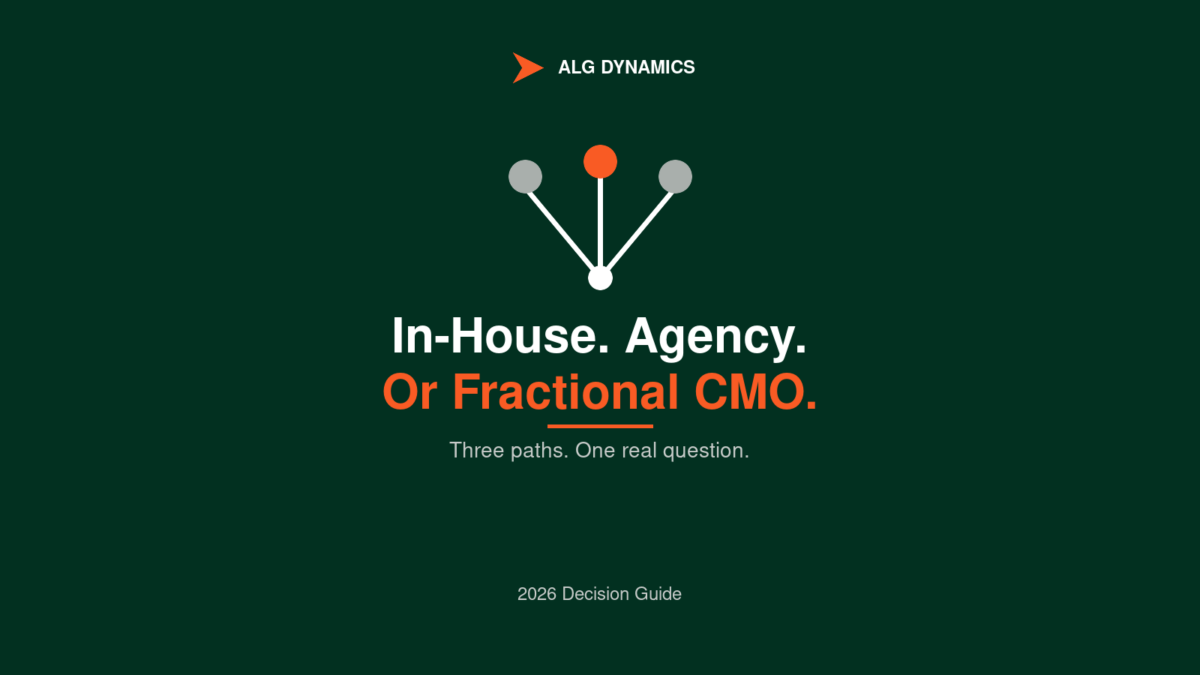
In-House vs Agency vs Fractional CMO: The Honest, Ultimate Guide
You have budget approved for marketing help and three people in your inbox making the case for three different answers. The in-house candidate wants a full-time role. The agency wants a retainer. The fractional CMO wants a smaller number of hours at a higher rate. All three sound reasonable in isolation.
The reason the in-house vs agency vs fractional CMO decision feels hard is that they are not different price points on the same service. They are three different shapes of capability, and the right one depends on what is actually missing in your marketing right now, not on which pitch was most convincing.
What Each Option Is Actually Built For
An in-house hire buys you dedicated attention and institutional memory. They learn your business, your customers, and your internal politics over time, and that knowledge compounds the longer they stay. The tradeoff is capacity: one person, even a strong one, has a ceiling on how many channels and skills they can cover well.
An agency buys you specialized execution across multiple channels at once: a team with SEO expertise, a team with paid media expertise, a team with design expertise, without hiring each one separately. Clutch’s 2026 digital marketing pricing data, drawn from more than 100,000 agencies, puts typical monthly project costs between $10,000 and $50,000, with hourly rates commonly landing between $25 and $150 depending on the service. The tradeoff is depth of strategic ownership: an agency executes well against a brief, but the brief usually still has to come from somewhere.
A fractional CMO buys you senior strategic judgment without the cost of a full-time executive. They set direction, prioritize what actually matters, and often manage the in-house hires or agency relationships underneath them. The tradeoff is hours: a fractional CMO is not the one physically producing content or running campaigns day to day.

The Question Underneath the Question
Most founders compare these three options on cost first, which is understandable and usually the wrong starting point. A cheaper option that solves the wrong problem is not actually cheap. The more useful starting question is what capability is missing: execution capacity, specialized channel skills, or strategic direction.
If you already know what to do and simply need someone doing it, you need capacity. That points toward in-house or an agency. If you know what to do but need it done across several specialized channels at once, an agency usually fits better than trying to hire five specialists in-house. If you do not yet know what the plan should be, adding capacity of any kind will not fix that. That points toward a fractional CMO, at least until the strategy exists for someone else to execute against.
In-House vs Agency vs Fractional CMO by Company Stage
Company stage narrows the decision further, because the capability gap tends to shift predictably as a business grows. Pre-revenue and early-stage businesses usually need direction more than volume, which favors a fractional CMO working a small number of hours a month. Businesses with a validated offer and some revenue often need both direction and execution, which is where a fractional CMO paired with a lean in-house hire or an agency tends to outperform either alone. Larger, more established businesses eventually need full-time strategic ownership, which is when an in-house CMO or VP of Marketing becomes the better long-term fit.
None of these stages are permanent. A business can start with a fractional CMO to build the strategy, bring in an agency to execute specific channels, and later hire in-house once the roadmap is proven enough for someone to run without building it from scratch.
Where This Differs From the In-House vs. Fractional CMO Question
If you have already read our in-house vs. fractional CMO breakdown, this is the same underlying logic extended to a third path. An agency is not a cheaper in-house hire and it is not a substitute for strategic direction. It is a way to buy specialized execution across channels without the overhead of separate full-time hires for each one, and it works best when the strategy guiding that execution already exists.
The In-House vs Agency vs Fractional CMO Mistake That Costs the Most
The costliest version of this decision is hiring for capacity when the actual gap is direction. A business with no clear strategy hires an agency, hands over a vague brief, and is disappointed six months later when spend has not translated into growth. The agency was never positioned to fail differently. It executed a plan that did not exist.
The fix is not always a different agency or a different hire. It is often establishing the direction first, so whichever option you choose next has something real to execute against.
FAQs
Is an agency cheaper than a fractional CMO?
Often, on a pure monthly cost basis, but they are not solving the same problem. An agency executes a defined scope of work well. A fractional CMO sets the direction that scope of work should follow. Comparing them purely on price ignores what each one is actually built to deliver.
Can a fractional CMO manage my agency relationship?
Yes, and it is one of the more common ways the two are combined. The fractional CMO sets strategy and reviews output, while the agency executes the channels that require full-time specialized attention.
When does an in-house hire make more sense than either option?
Once the strategy is proven enough that day-to-day execution no longer requires it to be rebuilt from scratch, and once the business has enough consistent volume to justify dedicated, full-time attention to marketing alone.
What’s the biggest mistake businesses make in the in-house vs agency vs fractional CMO decision?
Deciding based on which option is cheapest per month rather than which one addresses the actual gap. A cheap hire that executes the wrong plan costs more, in lost time and redirected budget, than a smaller, correctly targeted engagement.
Not Sure Which Model You Need?
Most founders hire before they know what is broken. The Marketing Clarity Intensive finds the root cause first, so your next hire or agency fixes the right problem.