



Content Marketing Audit: How to Find the 20% of Content Doing 80% of the Work
August 10, 2026
Best Fractional CMO Companies in 2026: How to Compare Them (Without the Hype)
August 14, 2026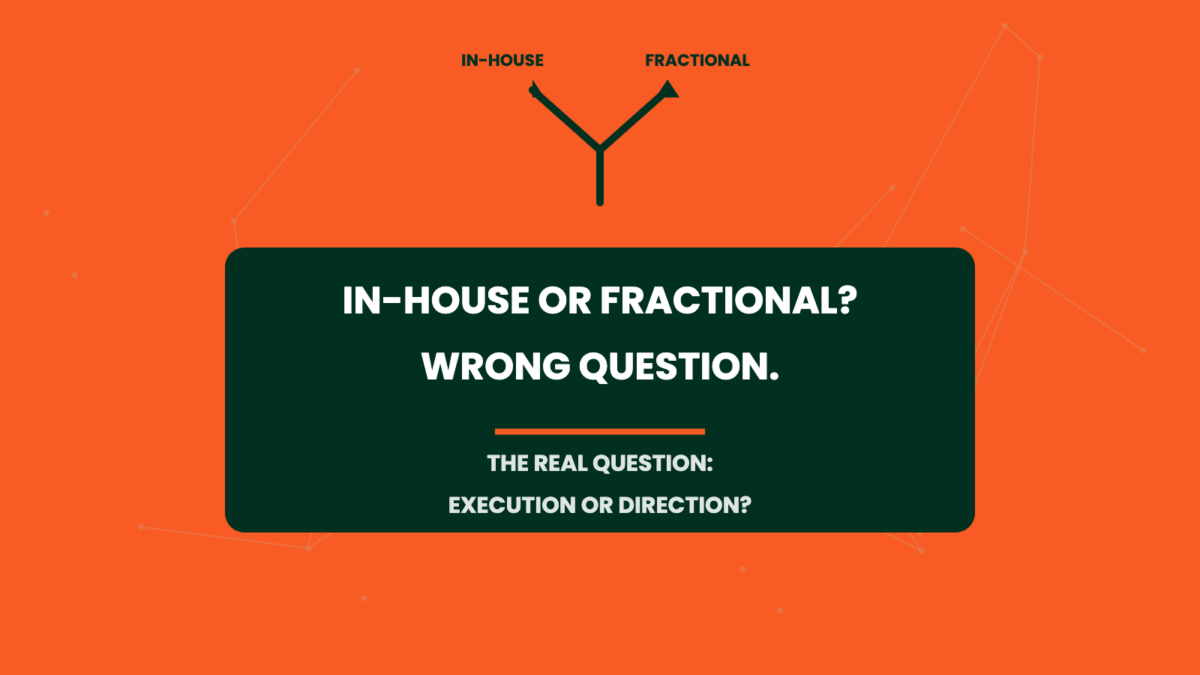
In-House Marketing vs. Fractional CMO: How to Choose (A Decision Framework)
A decision framework based on stage, budget, and the problem you’re actually solving.
You have budget approved for a marketing hire, and two very different paths in front of you. One is a full-time employee on your payroll by next quarter. The other is a fractional CMO who works ten to forty hours a month and answers to nobody's HR department. Both people you've talked to about this made a confident case for their side.
The question “in-house or fractional” is the wrong one to start with. The real question underneath it is whether you need execution or you need direction, and most founders have never separated those two needs before making the hire.
Answering that separates the real in-house marketing vs fractional CMO decision from a false either/or.
The real cost comparison
Getting the in-house marketing vs fractional CMO cost comparison right up front prevents a lot of wasted negotiating later.
A full-time marketing manager costs more than the salary line suggests. Add payroll tax, benefits, tooling, a laptop, management time, and three to six months of ramp before they're producing independently, and a $75,000 salary often lands closer to $110,000 to $130,000 in year-one loaded cost. A marketing director runs higher still, often $150,000 to $190,000 loaded, before results appear.
A fractional CMO working fifteen to twenty hours a month typically runs $4,000 to $9,000 monthly, or roughly $48,000 to $108,000 annualized, with no ramp period if you hire someone who already knows your industry. The comparison is not simply cheaper versus more expensive. It is buying a fixed forty hours a week of capacity versus buying a smaller number of hours from someone operating at a more senior level.
The 6 questions that decide it
Run through these six questions before you settle the in-house marketing vs fractional CMO question for your business.
1. Do you know what to do, or do you need someone to tell you? If you can hand someone a clear brief and trust them to execute it, you need capacity. If you cannot yet articulate the strategy you'd be asking them to execute, you need direction first.
2. Is the work strategic or executional? Running ad campaigns, writing content, and managing a calendar is executional work. Deciding what to say, to whom, and through which channels is strategic work. Most businesses that hire wrong are trying to buy the second with a role built for the first.
3. Can you manage a marketer? If you cannot evaluate whether the work in front of you is good, hiring junior and hoping they figure it out is a gamble you are not positioned to referee. A fractional CMO can manage that junior hire for you, which is often the highest-leverage use of the engagement.
4. How long is the runway? A fractional engagement can start delivering direction within the first month. A full-time hire needs three to six months before you can fairly judge their output, because part of that time is spent learning your business.
5. Do you need one brain or four hands? A single strategic mind making cross-channel decisions is a different need than a person physically producing content, running ads, and answering support tickets. Naming which one you actually need prevents hiring the wrong shape of person for the job.
6. What happens to the strategy if this person leaves? An in-house hire who leaves takes the strategy in their head with them. A fractional CMO who documents the system as they build it leaves you with something that survives their departure, which is worth asking about directly before you sign anything.
The hiring trap: buying execution to solve a strategy problem
This is exactly where the in-house marketing vs fractional CMO framing breaks down for most businesses.
Here is the mistake that costs the most money and gets discussed the least. A business with no clear strategy hires a marketing coordinator, hands them no direction beyond “grow our marketing,” and blames the coordinator nine months later when nothing has moved.
This is the core tension in any in-house marketing vs fractional CMO decision: capacity without direction produces motion, not results. Research from the Forbes Business Council on fractional executive trends echoes the same pattern seen across growth-stage companies weighing in-house marketing against a fractional CMO engagement.
The coordinator was never equipped to fail differently. They were hired to execute a plan that did not exist. The business needed direction, bought capacity instead, and mistook the resulting stall for a hiring mistake rather than a sequencing mistake.
The hybrid model nobody talks about
Framed as in-house marketing vs fractional CMO, the hybrid option rarely gets airtime, yet it resolves the tension most founders feel when comparing the two paths head to head.
The option most comparison articles skip entirely: a fractional strategist paired with a junior hire or a virtual assistant who executes what the strategist designs. For businesses under five million in revenue, this combination is often the correct answer, and it rarely appears in either the “hire in-house” or the “hire fractional” camp's pitch.
The strategist sets direction, builds the system, and reviews output. The junior hire or VA handles the volume: scheduling, drafting, reporting, campaign setup. You get senior thinking without paying a senior full-time salary, and you get execution capacity without asking a strategist to spend their time on tasks that don't require their judgment.
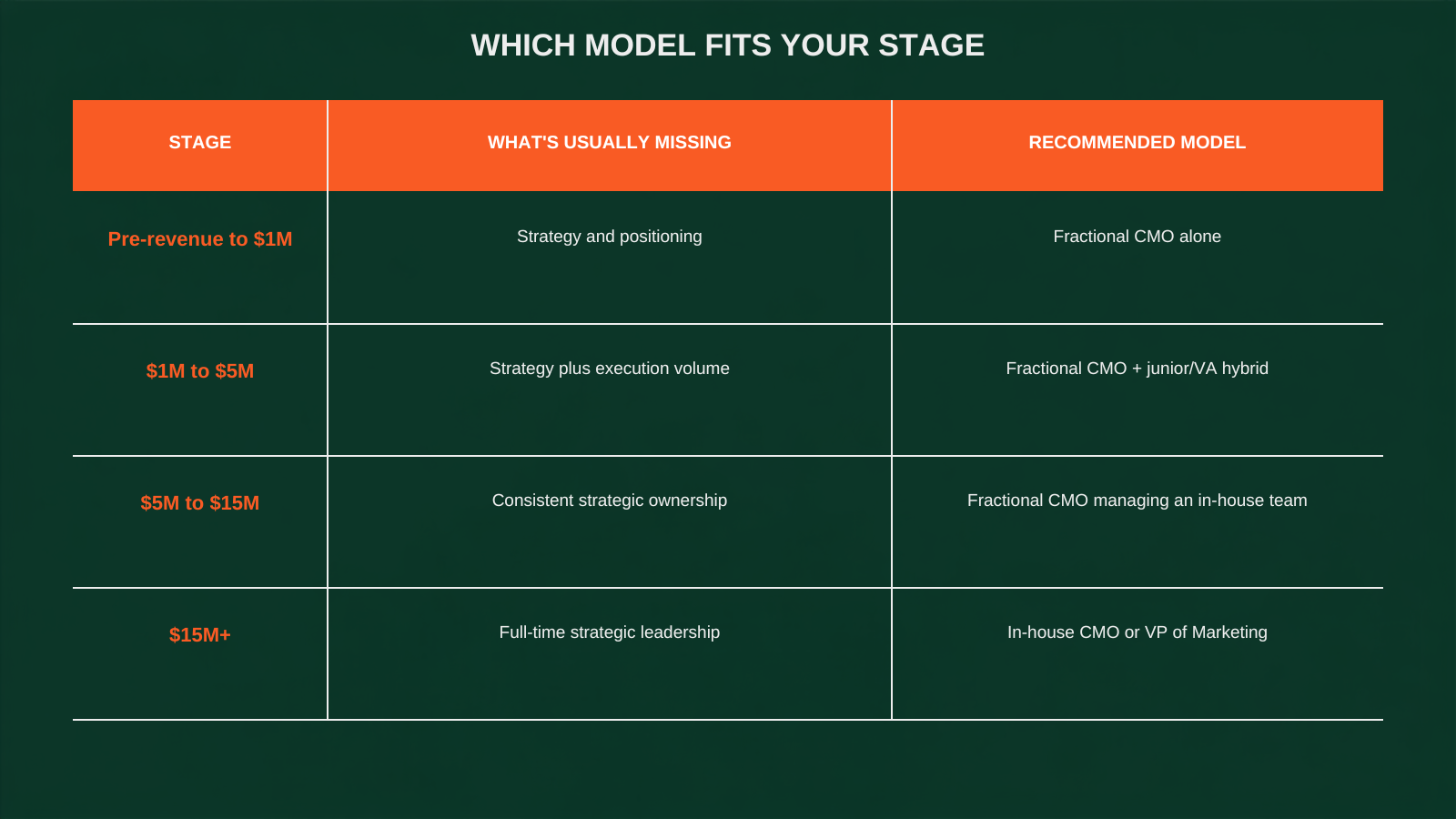
Decision table: stage to recommended model
This table maps the in-house marketing vs fractional CMO decision to your current revenue stage.
| Stage | What's usually missing | Recommended model |
|---|---|---|
| Pre-revenue to $1M | Strategy and positioning | Fractional CMO alone |
| $1M to $5M | Strategy plus execution volume | Fractional CMO + junior/VA hybrid |
| $5M to $15M | Consistent strategic ownership | Fractional CMO managing an in-house team |
| $15M+ | Full-time strategic leadership | In-house CMO or VP of Marketing |
Call it fractional CMO vs full-time CMO, fractional CMO vs full-time marketing director, or embedded growth pod vs fractional CMO. The same six questions above decide it faster than the label does.
Common mistakes in the in-house marketing vs fractional CMO decision
The most common mistake is deciding based on title rather than fit. Founders often assume a full-time hire signals more commitment, when in practice the fractional CMO frequently has more relevant pattern recognition from working across a dozen similar businesses. Title is not a proxy for judgment.
A second mistake is comparing monthly cost without comparing the cost of a wrong hire. A full-time marketing manager who spends six months executing the wrong strategy costs far more than the salary line suggests, once you count the lost quarter and the eventual severance or performance conversation. A fractional CMO who gets the direction wrong is far cheaper to correct, because the engagement can be adjusted or ended without the overhead of a termination.
A third mistake is treating the in-house marketing vs fractional CMO choice as permanent. Many businesses start with a fractional CMO to build the strategy and the system, then transition to an in-house hire once the roadmap is clear enough for someone to execute against it without building it from scratch. The sequencing, not the label, is what determines whether the hire succeeds.
What a fractional CMO will not fixEven after you resolve in-house marketing vs fractional CMO, some problems remain outside marketing entirely.
A fractional CMO cannot manufacture demand for a product nobody wants. They cannot fix a founder who overrides every recommendation before it has a chance to work. And they cannot substitute for budget: if there is no money to execute the strategy once it exists, the strategy has nowhere to go. Naming these limits plainly is more useful than pretending a hire of any kind solves problems outside marketing's control.
FAQs
A few more angles on the in-house marketing vs fractional CMO decision, answered directly below.
Is a fractional CMO cheaper than an in-house hire?
Usually, on loaded cost. But compare on outcome per dollar rather than headcount. A cheaper hire that produces no strategic direction is not actually the lower-cost option.
When should I hire a fractional CMO instead of a marketing manager?
When the gap in your business is direction, not capacity. A marketing manager needs a strategy to execute; a fractional CMO builds the strategy.
Can a fractional CMO manage my existing team?
Yes, and it is often the highest-leverage use of the engagement, since it lets your existing hires execute against a real plan instead of guessing.
How many hours a month does a fractional CMO work?
Typically ten to forty. Ten to fifteen hours suits an early-stage business needing quarterly direction. Thirty to forty suits a business needing closer weekly involvement.
What size company needs a fractional CMO?
For the in-house marketing vs fractional CMO question specifically, most commonly businesses between one and fifteen million in revenue, though the honest counter-case is any business at any size that has clarity on strategy already and simply needs more hands.
The in-house marketing vs fractional CMO question ultimately comes down to sequencing, not just budget. Hiring decisions like this one are identity decisions as much as budget decisions. The founder who hires in-house is often answering “am I the kind of business that has a marketing team” more than “what does my marketing actually need right now.” Either choice can work. Neither one works without a growth system underneath it first.