



Best Fractional CMO Companies in 2026: How to Compare Them (Without the Hype)
August 14, 2026
B2B Fractional CMO: What They Do, What They Cost, and When You Need One
August 19, 2026
Fractional CMO for Startups: When It Works, When It’s a Waste of Money
Your seed round closed four months ago. You have twelve people, a product with real usage, and a marketing budget that covers one senior hire, maybe. Someone on your board mentioned a fractional Chief Marketing Officer (CMO). You looked into it, found a dozen firms promising senior leadership at a fraction of full-time cost, and now you are trying to work out if that solves your problem or just delays it.
A fractional CMO for startups works when the company has reached early product-market fit (PMF) and needs senior direction without a full-time salary. It fails when the startup is still pre-PMF, when the founder will not hand over control of the message, or when there is no budget to test what the CMO recommends. Stage matters more than title.
That distinction gets lost in most of the content written about fractional CMOs, because most of it is written by fractional CMOs trying to sell the engagement. The honest version includes the cases where the answer is no.
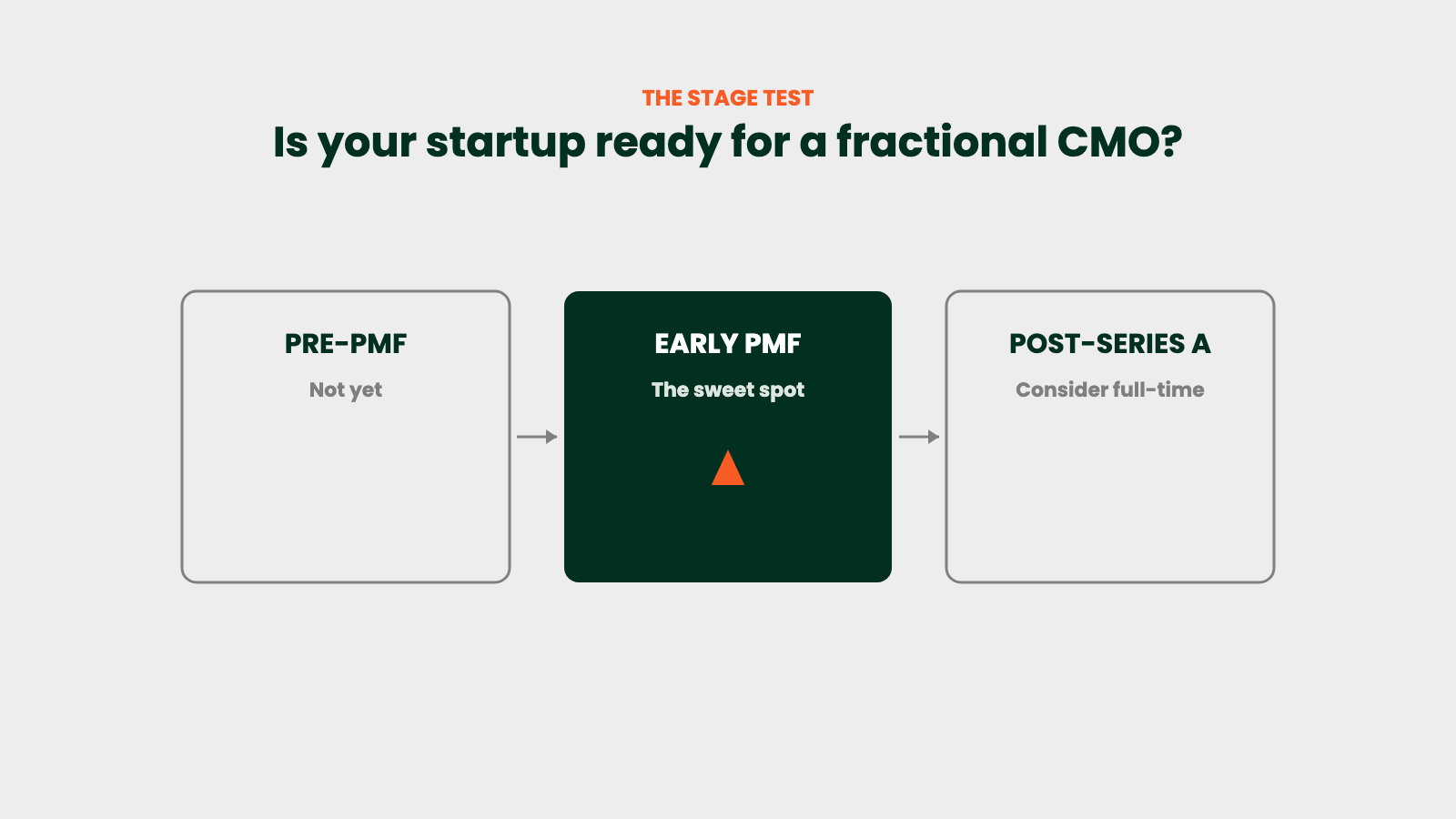
The stage test: is your startup ready for a fractional CMO?
The single question that predicts whether a fractional CMO engagement will work has nothing to do with budget. It is whether the company has evidence that people will pay for what it built. A fractional CMO is a force multiplier. Multiplying zero still produces zero.
Pre-product-market-fit: almost always no, and why
If you have not found repeatable demand, a fractional CMO cannot manufacture it. Positioning work assumes you know who buys and why. Channel selection assumes you have a signal worth amplifying. Neither exists yet at this stage, so the engagement becomes expensive guessing dressed up as strategy.
What actually happens in these engagements: the CMO runs customer interviews that mostly confirm what the founder already suspected, drafts a positioning document nobody tests against real buyers, and picks a channel based on convention rather than evidence. Three months later, the company has a nicer deck and the same revenue problem.
The founders who hire at this stage are usually not buying marketing. They are buying reassurance that someone senior is handling growth while they focus on product. That reassurance costs five figures a month and produces very little a diagnostic engagement could not surface for less.
Early PMF, founder-led sales working: the sweet spot
This is the stage where a fractional CMO earns the fee. The founder has closed a repeatable set of deals, usually through direct sales or a founder-led motion, and can describe why the last ten customers bought. There is a pattern. Nobody has systematized it yet.
A fractional CMO at this stage takes an informal, founder-dependent motion and turns it into something repeatable that does not require the founder in every deal. That is a genuinely different job than positioning a company that has no signal. It is closer to translation than invention.
If that describes where you are, the work itself is what Growth Architecture builds: turning an informal, founder-led motion into the positioning, channel, and system a fractional engagement is supposed to produce.
Post-Series A scaling: you may need full-time
Once the company is hiring a sales team, running multiple channels simultaneously, and coordinating with product on a roadmap that marketing has to support, the job becomes execution management as much as direction-setting. A fractional CMO working ten to twenty hours a week cannot sit in the daily coordination a growth-stage company needs.
Companies at this stage sometimes keep a fractional CMO on for strategic oversight while hiring a full-time director of marketing to run execution. That hybrid model works. Trying to run the whole function on fractional hours past this stage usually does not.
Be honest with yourself about which of these three stages describes your fractional CMO for startups situation. A firm willing to tell a prospective client they are not ready is rare, and that willingness is usually the clearest signal of whether the firm is worth trusting on anything else.
What a Fractional CMO for Startups Actually Does
The job is positioning, ideal customer profile (ICP) definition, channel selection, building the first repeatable motion, and setting up the hiring plan for whoever executes next. It is not running ads. It is not writing blog posts. It is not managing a social calendar.
That distinction matters because most of the disappointment with fractional CMO engagements comes from a mismatch in expectations. Founders hire someone at a strategic day rate and expect campaign output. What they actually get, when the engagement is working, is a small number of high-impact decisions: who you are selling to, what you say to them, which channel earns the first repeatable win, and who you need to hire to keep it running once the fractional CMO steps back.
Everything downstream of those decisions, the ad creative, the landing pages, the content calendar, gets executed by someone else: a specialist contractor, an early marketing hire, or the founder personally for a few more months. The fractional CMO’s job is to make sure that execution is not guessing.
The first 90 days: what good looks like
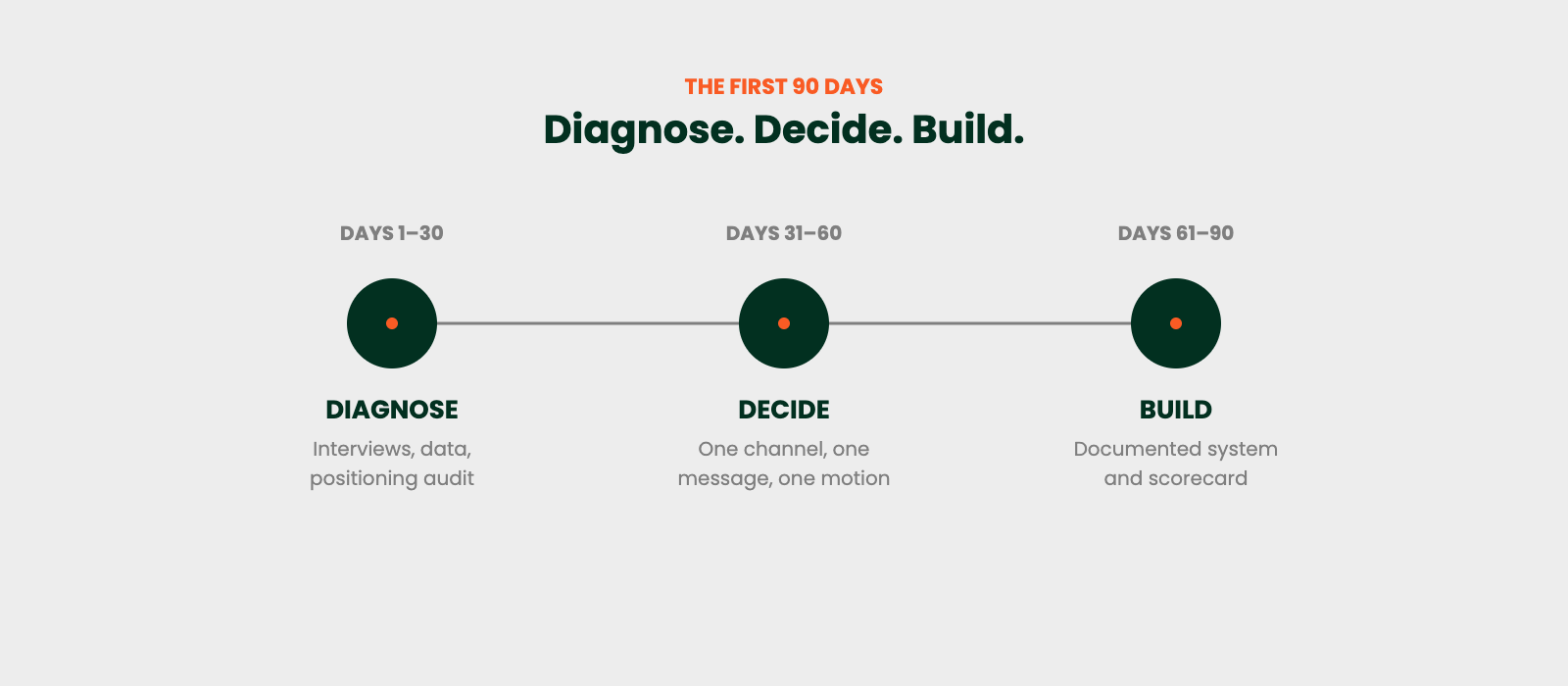
Days 1–30: diagnose
The first month is customer interviews, a review of whatever data exists, and an honest audit of current positioning against what customers actually say when they describe why they bought. Most startups are surprised by the gap between the story they tell about themselves and the story their customers actually tell.
Days 31–60: decide
The second month narrows everything to one channel, one core message, and one motion to test. Startups at this stage do not have the budget or the attention to run three channels at once and see which wins. A fractional CMO worth the retainer picks one, states the hypothesis plainly, and commits to a real test instead of a soft rollout.
Days 61–90: build the system and the scorecard
The third month is where the informal becomes repeatable. That means documented messaging, a defined ICP with real criteria instead of a vague description, a working channel with early signal, and a scorecard that tracks the two or three numbers that actually predict growth for this specific business.
A founder should demand a specific deliverable list from any fractional CMO engagement by day 90: a positioning document, an ICP definition with disqualifying criteria, one validated channel with early conversion data, and a scorecard with defined metrics and current baselines. If day 90 arrives without those four things, the engagement is not working, regardless of how many meetings happened.
Why fractional CMOs fail at startups
This section rarely appears in content written by fractional CMOs, which is itself a signal of why it needs to exist. There are three specific ways these engagements fail, and none of them are about the CMO’s competence.
The founder will not relinquish message control. Some founders hire a fractional CMO, then override every recommendation because the messaging does not match how they personally talk about the product. If the founder will not test language other than their own instinct, the engagement becomes theater.
There is no budget to test what gets recommended. A fractional CMO can identify the right channel and the right message. Neither means anything without enough spend or enough time to see whether the hypothesis holds. Startups sometimes hire the strategist and skip the testing budget, which guarantees the strategy stays theoretical.
The CMO was hired to validate a decision the founder already made. This is the most common failure and the hardest to see from the inside. The founder wants a senior name behind a channel choice or a positioning angle already settled on. The fractional CMO’s actual analysis gets quietly ignored the moment it conflicts with what the founder wanted to hear.
The pre-PMF alternative: a diagnostic, not a hire
If you are pre-product-market-fit, a fractional CMO for startups is not the right move yet. What you need is clarity on why the plan is not working, which is a different kind of engagement entirely.
The Marketing Clarity Intensive exists for exactly this stage. We diagnose where your current positioning and messaging are breaking down before you commit to a monthly retainer for someone to execute against a foundation that has not been tested yet. You get a documented assessment either way, whether or not you continue past it.
Hiring a fractional CMO before that clarity exists usually means paying senior rates for work a diagnostic could have surfaced for a fraction of the cost, in a fraction of the time.
Fractional CMO for Startups: Cost vs. a Full-Time VP Marketing
A fractional CMO typically runs $5,000 to $20,000 a month, depending on hours and seniority, with most engagements in the $8,000 to $12,000 range for a growth-stage startup working roughly twenty to forty hours a month. A full-time VP of Marketing at a startup usually costs $200,000 to $300,000 a year once salary, benefits, and equity are counted, before adding recruiting time and the months it takes a new hire to reach full productivity.
The math is not simply monthly cost divided by hours. A full-time VP of Marketing is available for the operational work a fractional CMO deliberately does not do: managing a growing team, sitting in daily coordination with sales and product, owning execution as well as direction. A fractional CMO is the right cost structure when the company needs direction more than headcount. A full-time hire is the right cost structure once the company needs both.
For the full breakdown of pricing models and hidden fees, see fractional CMO cost.
How to Measure a Fractional CMO for Startups
Measure the engagement against the four deliverables from the 90-day plan, not against revenue in the first quarter. Revenue at an early-stage startup is affected by too many variables outside marketing’s control to serve as a fair 90-day scorecard.
After 90 days, the right measurement shifts to leading indicators tied to the one channel and motion the engagement built: conversion rate on the validated channel, pipeline generated against the defined ICP, and whether the messaging is holding up in real sales conversations without the founder having to correct it. If those three are moving in the right direction by month four or five, the engagement is working.
FAQs
Fractional CMO for Startups: Do You Need One?
A fractional CMO for startups only pays off after early product-market fit. Before that, a diagnostic engagement will tell you more for less money.
How Much Does a Fractional CMO for Startups Cost?
Most startup engagements run $5,000 to $12,000 a month, compared to $200,000 or more a year fully loaded for a full-time VP of Marketing.
When is it too early for a fractional CMO?
Pre-product-market-fit, without budget to test recommendations, or with a founder unwilling to hand over control of the message.
What should a fractional CMO deliver in 90 days?
A positioning document, a defined ICP, one validated channel with early data, and a scorecard with real baselines.
Fractional CMO vs. growth agency for startups?
A fractional CMO sets direction. A growth agency executes against direction that already exists. Most startups that hire an agency actually needed the first one.
The founders who get real value from a fractional CMO for startups are the ones willing to hear that they are not ready yet, if that happens to be true. If you can describe why your last ten customers bought, you are probably past that point. If you cannot, that is the actual problem worth solving first.
A SaaS marketing audit is a reasonable next step if you want a structural read on where your current marketing is leaking before you commit to any engagement, fractional or otherwise.