



Free Digital Marketing Audit: What It Can Find, and What It Will Always Miss
July 21, 2026
B2B Marketing Audit: How to Diagnose a Pipeline That Stalled
July 21, 2026
SaaS Marketing Audit: Find the Leak Between Signup and Revenue
Traffic and signups are up, but MRR is flat. Here is the audit that looks past acquisition to where SaaS companies actually lose revenue.
Traffic is up. Signups are up. Monthly recurring revenue (MRR) is flat. If that sentence describes your dashboard, the problem is not acquisition, and no amount of additional ad spend will fix it. A SaaS marketing audit looks past the top of the funnel to the place where most SaaS companies actually lose revenue: the gap between signup and genuine product activation.
Why most SaaS marketing audits look at the wrong end of the funnel
Acquisition obsession is easy to fall into because it is the most visible number. But if your activation rate sits at 12 percent, sending more traffic into that funnel is not growth, it is arson. You are simply burning more people through the same broken step faster.
The SaaS marketing audit: 8 checks
1. Ideal customer profile (ICP) vs. actual paying-customer profile
Pull your last twenty paying customers and compare them against your stated ideal customer profile. They are rarely the same list, and the gap tells you exactly who you should actually be targeting.
2. Positioning against the alternative
Your real competitor is often not another SaaS tool. It is a spreadsheet, or doing nothing at all. Check whether your positioning actually argues against those alternatives, not just against other software.
3. Acquisition channel efficiency
Measure customer acquisition cost (CAC) by channel and payback period, not just signup volume. A channel that is cheap per signup but slow to pay back is quietly draining cash.
4. Signup-to-activation conversion
This is the number that matters most and gets audited least. Measure exactly what percentage of signups reach a genuine "aha" moment, not just account creation.
5. Time-to-first-value
Measure how long it takes a new user to experience the specific value your product promised them. Every extra minute is a chance for them to give up and never come back.
6. Onboarding message sequence
Review what your product and email sequence actually say to a brand-new user in their first week. A generic welcome series talking about features nobody has used yet wastes the highest-attention window you will ever get with that customer.
7. Churn reasons vs. stated churn reasons
The reason a customer gives when they cancel is rarely the full reason. Compare stated churn reasons against usage data from their final thirty days to find the real pattern.
8. Expansion and pricing-page friction
Check whether your pricing page and in-app upgrade prompts make it easy for a growing customer to expand, or whether friction there is quietly capping your expansion revenue.
The activation audit competitors skip entirely
Growth blogs audit ad spend and SEO exhaustively. Almost none of them audit the first ten minutes of product experience as a marketing problem, treating it instead as a product or UX concern to hand off elsewhere. That is a mistake worth owning here: the first session is a persuasion sequence, not a UX flow, and it deserves the same scrutiny as your homepage copy.
Map your onboarding as a sequence of persuasive moments, not a checklist of features to click through. Every step either builds the user's belief that this product works for them, or erodes it.
Auditing your churn interviews for what customers won't say
When a customer cancels and says "too expensive," that is rarely the full story. The real reason is more often "I never got value," dressed in a more comfortable explanation. Run exit interviews with a specific script that separates the stated reason from the underlying one: ask what they hoped would happen when they signed up, and whether it did.
Reading the results: three SaaS diagnoses
| Diagnosis | What It Means | The Fix |
|---|---|---|
| Leaky bucket | Healthy signups but poor activation, the most common SaaS diagnosis | Onboarding and time-to-value work, not more spend |
| Wrong bucket | You are activating the wrong customers, who churn quickly regardless of onboarding quality | ICP and positioning |
| No bucket | Genuine demand is thin regardless of channel | Starts at message-market fit, not tactics |
The 30-60-90 after the audit
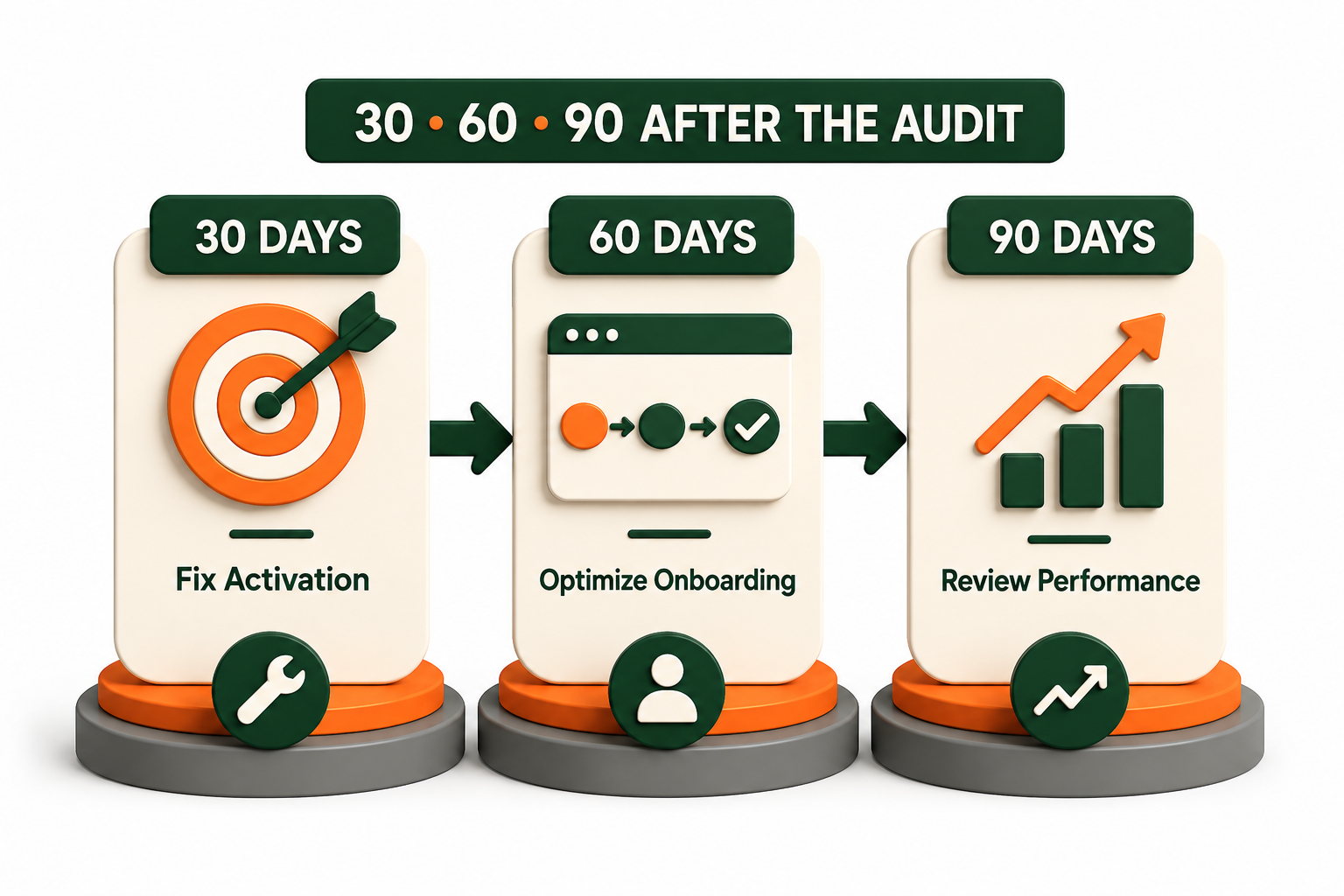
In the first 30 days, fix the single highest-impact activation step you identified. In 60, rebuild the onboarding sequence around the true first-value moment. In 90, revisit CAC and payback with the new activation numbers in hand.
FAQs
What is a SaaS marketing audit?
An end-to-end diagnosis from demand through activation, retention, and expansion, not just top-of-funnel traffic and signups.
What SaaS metrics should an audit cover?
CAC, payback period, activation rate, time-to-value, net revenue retention, and expansion rate.
Why isn't more traffic growing our MRR?
Because activation, not acquisition, is usually the binding constraint. If only 12 percent of signups activate, tripling traffic only triples the number of people who do not activate.
How often should a SaaS company audit its marketing?
Every two quarters, and always before raising ad spend significantly or before a funding round.
Should a seed-stage SaaS bother with an audit?
Yes. The cost of scaling a broken funnel is far higher than the cost of the audit that would have caught it early. See the B2B marketing audit framework.
Common mistakes in a SaaS marketing audit
The most common mistake in a SaaS marketing audit is treating trial signups as the finish line. A SaaS marketing audit that stops at signup volume will miss the actual leak, which almost always sits between activation and the first paid conversion.
Benchmarks from OpenView's SaaS benchmarks research reinforce what a careful SaaS marketing audit usually finds: product-qualified signals predict revenue far better than raw signup counts.
A SaaS marketing audit is only as useful as the activation event it is built around. Pick the wrong milestone and the audit will chase the wrong number for a full quarter.
Teams that skip a SaaS marketing audit tend to keep funding the same acquisition channels every quarter, even after the leak has moved somewhere else in the funnel. A SaaS marketing audit run on a fixed cadence, not just when growth stalls, catches that shift before it shows up in the board deck.
SaaS Marketing Audit: Find the Leak Between Signup and Revenue
Traffic and signups are up, but MRR is flat. Here is the audit that looks past acquisition to where SaaS companies actually lose revenue.
Traffic is up. Signups are up. Monthly recurring revenue (MRR) is flat. If that sentence describes your dashboard, the problem is not acquisition, and no amount of additional ad spend will fix it. A SaaS marketing audit looks past the top of the funnel to the place where most SaaS companies actually lose revenue: the gap between signup and genuine product activation.
Why most SaaS marketing audits look at the wrong end of the funnel
Acquisition obsession is easy to fall into because it is the most visible number. But if your activation rate sits at 12 percent, sending more traffic into that funnel is not growth, it is arson. You are simply burning more people through the same broken step faster.
The SaaS marketing audit: 8 checks
1. Ideal customer profile (ICP) vs. actual paying-customer profile
Pull your last twenty paying customers and compare them against your stated ideal customer profile. They are rarely the same list, and the gap tells you exactly who you should actually be targeting.
2. Positioning against the alternative
Your real competitor is often not another SaaS tool. It is a spreadsheet, or doing nothing at all. Check whether your positioning actually argues against those alternatives, not just against other software.
3. Acquisition channel efficiency
Measure customer acquisition cost (CAC) by channel and payback period, not just signup volume. A channel that is cheap per signup but slow to pay back is quietly draining cash.
4. Signup-to-activation conversion
This is the number that matters most and gets audited least. Measure exactly what percentage of signups reach a genuine “aha” moment, not just account creation.
5. Time-to-first-value
Measure how long it takes a new user to experience the specific value your product promised them. Every extra minute is a chance for them to give up and never come back.
6. Onboarding message sequence
Review what your product and email sequence actually say to a brand-new user in their first week. A generic welcome series talking about features nobody has used yet wastes the highest-attention window you will ever get with that customer.
7. Churn reasons vs. stated churn reasons
The reason a customer gives when they cancel is rarely the full reason. Compare stated churn reasons against usage data from their final thirty days to find the real pattern.
8. Expansion and pricing-page friction
Check whether your pricing page and in-app upgrade prompts make it easy for a growing customer to expand, or whether friction there is quietly capping your expansion revenue.
The activation audit competitors skip entirely
Growth blogs audit ad spend and SEO exhaustively. Almost none of them audit the first ten minutes of product experience as a marketing problem, treating it instead as a product or UX concern to hand off elsewhere. That is a mistake worth owning here: the first session is a persuasion sequence, not a UX flow, and it deserves the same scrutiny as your homepage copy.
Map your onboarding as a sequence of persuasive moments, not a checklist of features to click through. Every step either builds the user’s belief that this product works for them, or erodes it.
Auditing your churn interviews for what customers won’t say
When a customer cancels and says “too expensive,” that is rarely the full story. The real reason is more often “I never got value,” dressed in a more comfortable explanation. Run exit interviews with a specific script that separates the stated reason from the underlying one: ask what they hoped would happen when they signed up, and whether it did.
Reading the results: three SaaS diagnoses
| Diagnosis | What It Means | The Fix |
|---|---|---|
| Leaky bucket | Healthy signups but poor activation, the most common SaaS diagnosis | Onboarding and time-to-value work, not more spend |
| Wrong bucket | You are activating the wrong customers, who churn quickly regardless of onboarding quality | ICP and positioning |
| No bucket | Genuine demand is thin regardless of channel | Starts at message-market fit, not tactics |
The 30-60-90 after the audit
In the first 30 days, fix the single highest-impact activation step you identified. In 60, rebuild the onboarding sequence around the true first-value moment. In 90, revisit CAC and payback with the new activation numbers in hand.
FAQs
What is a SaaS marketing audit?
An end-to-end diagnosis from demand through activation, retention, and expansion, not just top-of-funnel traffic and signups.
What SaaS metrics should an audit cover?
CAC, payback period, activation rate, time-to-value, net revenue retention, and expansion rate.
Why isn’t more traffic growing our MRR?
Because activation, not acquisition, is usually the binding constraint. If only 12 percent of signups activate, tripling traffic only triples the number of people who do not activate.
How often should a SaaS company audit its marketing?
Every two quarters, and always before raising ad spend significantly or before a funding round.
Should a seed-stage SaaS bother with an audit?
Yes. The cost of scaling a broken funnel is far higher than the cost of the audit that would have caught it early. See the B2B marketing audit framework.
Common mistakes in a SaaS marketing audit
The most common mistake in a SaaS marketing audit is treating trial signups as the finish line. A SaaS marketing audit that stops at signup volume will miss the actual leak, which almost always sits between activation and the first paid conversion.
Benchmarks from OpenView’s SaaS benchmarks research reinforce what a careful SaaS marketing audit usually finds: product-qualified signals predict revenue far better than raw signup counts.
A SaaS marketing audit is only as useful as the activation event it is built around. Pick the wrong milestone and the audit will chase the wrong number for a full quarter.
Teams that skip a SaaS marketing audit tend to keep funding the same acquisition channels every quarter, even after the leak has moved somewhere else in the funnel. A SaaS marketing audit run on a fixed cadence, not just when growth stalls, catches that shift before it shows up in the board deck.
Recommended next steps
Build a stronger SaaS growth architecture • Connect marketing and revenue systems • Discuss the highest-impact growth constraint