

In-House vs Agency vs Fractional CMO: The Honest, Ultimate Guide
August 28, 2026
How to Identify the Real Bottleneck Blocking Business Growth
September 30, 2026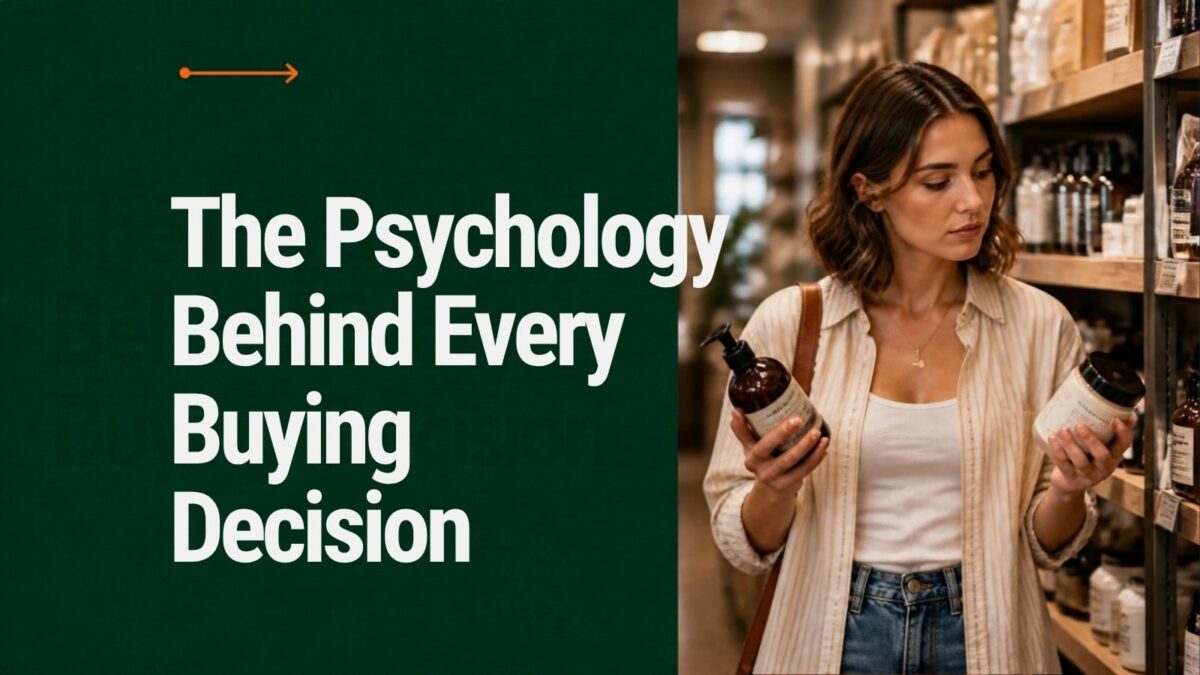
Consumer Psychology in Marketing: A Practical Guide
Consumer psychology in marketing is the study of why people notice, trust, and choose one option over another. It explains far more about buying behavior than any individual tactic can on its own. The field draws on decades of research in cognitive bias, decision-making, and motivation to describe patterns such as loss aversion, social proof, and choice overload. For a small business owner, the value of understanding these patterns is not manipulation. It is removing the friction and confusion that keep an otherwise interested buyer from deciding.
What Consumer Psychology Actually Explains
Most marketing advice focuses on execution: which channel to use, how often to post, what subject line gets opened. Consumer psychology sits underneath all of that. It explains why two businesses can run the same tactic, on the same channel, with the same budget, and get different results. The difference usually comes down to whether the marketing accounts for how people actually process information and make decisions, rather than how a business assumes they do.
Decision-making research going back to psychologists Daniel Kahneman and Amos Tversky, including their 1979 paper on Prospect Theory, shows that people rely on mental shortcuts, known as heuristics, far more than they rely on careful analysis. A buyer comparing two service providers is rarely running a spreadsheet of features. They are pattern-matching against past experience, weighing perceived risk, and looking for signals that reduce uncertainty. Marketing that ignores this and simply lists features and benefits is talking past the way the decision actually gets made.
If your marketing activity is increasing but the reason buyers hesitate is still unclear, the Marketing Clarity Intensive is designed to identify where the decision is breaking down before more budget goes into execution.
Explore the Marketing Clarity IntensiveWhy Tactics Fail Without a Psychological Foundation
A landing page redesign, a new ad angle, or a longer email sequence can each perform well or poorly depending on what happens beneath the surface. This is the same principle behind ALG Dynamics’ Diagnosis Before Prescription approach to Growth Architecture: a tactic applied to the wrong underlying problem produces inconsistent results, no matter how well it is executed.
Consumer psychology gives founders a way to diagnose that underlying problem before choosing a tactic. If a business is getting traffic but no sales, the fix might not be a better offer. It might be that buyers face too many similar options and disengage rather than choose, a pattern researchers call choice overload. If a business struggles to differentiate on price, the fix might not be a discount. It might be that the messaging speaks to functional benefits while the buyer is actually motivated by a social or emotional job the product does for them.
Core Psychological Principles That Shape Buying Decisions
The table below summarizes five well-documented principles that show up consistently in small business marketing, along with what each one looks like in practice.
| Principle | What It Means | How It Shows Up in Small Business Marketing |
|---|---|---|
| Loss Aversion | Losses feel roughly twice as painful as equivalent gains feel good | Messaging framed around what a business is losing, such as wasted spend or missed leads, often outperforms gain-framed messaging |
| Social Proof | People judge decisions as safer when others like them have made the same choice | Specific, verifiable testimonials and case studies outperform generic praise or star ratings alone |
| Choice Overload | Too many similar options can reduce the likelihood that any decision gets made | A menu of five near-identical service packages often converts worse than two clearly differentiated ones |
| Functional, Emotional, and Social Jobs | Buyers hire a product or service to do more than one job: a practical task, a feeling, and a signal to others | Messaging that only addresses the functional job misses why a buyer actually chose it |
| Anchoring | The first number or option a buyer sees shapes how they judge every option after it | Pricing pages that lead with the highest tier make mid-tier options look more reasonable by comparison |
Loss Aversion
Loss aversion describes the tendency to weigh the pain of losing something more heavily than the pleasure of gaining something of equal value. This is why messaging framed around what a business is currently losing often creates more urgency than messaging framed purely around potential gains. Wasted ad spend, missed leads, and hours lost to manual follow-up are all losses a buyer already feels.
Social Proof
People look to the behavior of others, especially people similar to them, to judge whether a decision is safe. For a small business, this principle explains why testimonials from a comparable company carry more weight than generic praise, and why a case study with specific, verifiable detail outperforms a broad claim of results.
Choice Overload
Research by psychologists Sheena Iyengar and Mark Lepper, published in the Journal of Personality and Social Psychology in 2000, found that presenting people with too many options can reduce, rather than increase, the likelihood that they choose at all. Small businesses often assume more packages or more features signal more value. In practice, an unclear menu of options frequently increases hesitation and abandonment.
Applying Consumer Psychology Without Manipulating Anyone
There is a meaningful difference between using psychology to clarify a genuine decision and using it to manufacture false urgency or exploit anxiety. ALG Dynamics’ Psychology Before Persuasion principle treats consumer psychology as a diagnostic tool, not a trick. The goal is to understand why a buyer hesitates, then remove that specific friction, rather than to pressure a decision the buyer has not actually reached.
This distinction matters practically. Manufactured urgency tends to work once and damage trust permanently. A countdown timer with no real deadline is one example. A claim of limited spots that is not true is another. Structural clarity tends to compound. That means accurate social proof, a simplified set of options, and transparent pricing. It compounds because it makes every future interaction with that buyer easier, not just the one that gets a name added to an email list.
Common Mistakes When Small Businesses Apply Psychology to Marketing
Two mistakes show up repeatedly. The first is applying a single principle in isolation, most often social proof or scarcity, without addressing the underlying structural problem in positioning or offer clarity. A testimonial cannot fix an unclear value proposition. If you suspect the problem sits deeper than the copy, a structured marketing audit is usually the faster way to find it. The second is treating psychological principles as copywriting tricks rather than as a lens for understanding the buyer’s actual reasoning, which leads to language that feels performative rather than credible.
Building Psychological Literacy Into a Marketing Team
Consumer psychology is not a one-time framework to apply and forget. Buyer behavior shifts as markets, channels, and expectations change, and a team that understands the underlying principles can adapt messaging and offers without waiting for an outside audit every time something stops working. This is the specific skill gap that ALG Dynamics’ Strategic Marketing and AI Literacy Training is built to close: giving founders and internal teams the practical decision-making framework to evaluate their own marketing, rather than depending permanently on outside interpretation.
Frequently Asked Questions
What is consumer psychology in marketing?
Consumer psychology in marketing is the study of the mental processes, biases, and motivations that shape how people notice, evaluate, and choose between options. It draws on established behavioral science, including loss aversion and social proof, to explain buying patterns that surface-level marketing tactics alone cannot.
How is consumer psychology different from persuasion techniques?
Persuasion techniques focus on getting someone to act. Consumer psychology focuses on understanding why someone hesitates or decides in the first place. Used well, psychology diagnoses the actual barrier to a decision. Used poorly, persuasion tactics apply pressure without addressing that barrier, which tends to produce short-term results and long-term distrust.
What is the most common consumer psychology mistake small businesses make?
The most common mistake is applying an isolated tactic, like adding a testimonial or a countdown timer, without fixing the structural issue underneath it, such as unclear positioning or a confusing set of options. Psychology principles amplify clarity. They do not replace it.
Do I need a psychology background to apply this?
No. The core principles, loss aversion, social proof, choice overload, and similar patterns, are well documented and can be learned and applied practically without formal training. What matters more is a structured way to diagnose which principle is relevant to a specific buying friction, rather than memorizing every academic term.
How does AI change the use of consumer psychology in marketing?
AI tools can help identify patterns in customer language and behavior faster, but they do not replace the judgment needed to interpret what those patterns mean for a specific business. AI-generated messaging that ignores psychological grounding often reads as generic, which is itself a trust signal buyers pick up on.
What is marketing psychology?
Marketing psychology is the study of how people notice, evaluate and choose what to buy, applied to how a business positions its offer, writes its messages and designs its customer journey. It is the same field as consumer psychology in marketing, seen from the seller’s side. Instead of asking why customers behave the way they do, it asks what the business should change so its marketing fits that behavior.
Where should a small business start with consumer psychology?
Start where prospects stall. Pick one step in your customer journey where people drop off, such as a pricing page, a quote request or a follow-up email. Ask which decision the customer is being asked to make at that step, and what makes that decision feel risky or unclear. Fixing one friction point based on how people actually decide usually teaches more than applying a list of persuasion tactics across the whole site.
Where This Leads
Understanding consumer psychology will not fix a marketing program on its own. It changes what a founder looks for when something is not working.
A practical next step is to test one change at a time. Simplify an offer, rewrite a page around the buyer’s real hesitation, or add specific social proof, then measure the result. ALG Dynamics’ free Growth Experiment Planner gives you a simple structure for scoring and testing those changes before you commit budget to them.
Which hesitation is your buyer carrying that your marketing has never named?