



How to Choose a Digital Marketing Audit Company (7 Questions That Filter Out the Pitch)
August 5, 2026
Website Marketing Audit: Why Traffic Arrives and Nobody Converts
August 7, 2026
What Is a Marketing Audit? Definition, Types, and What It Actually Finds
The four-layer framework that defines what a marketing audit actually is, and what it isn't.
Most owners don't need more marketing. They need to know which part is lying to them.
What is a marketing audit?
A marketing audit is a structured evaluation of your demand, message, channel presence, and conversion path, designed to identify exactly where your marketing is losing money and why. That is the marketing audit definition worth using, because it names a mechanism, not just an activity.
It exists because most marketing problems are invisible from inside the business that has them.
The 4 layers a marketing audit covers
A real marketing audit examines four distinct layers, and most self-audits only ever check the first two. Most marketing audits fail here, not because the layers are hard to name, but because they are hard to check honestly.
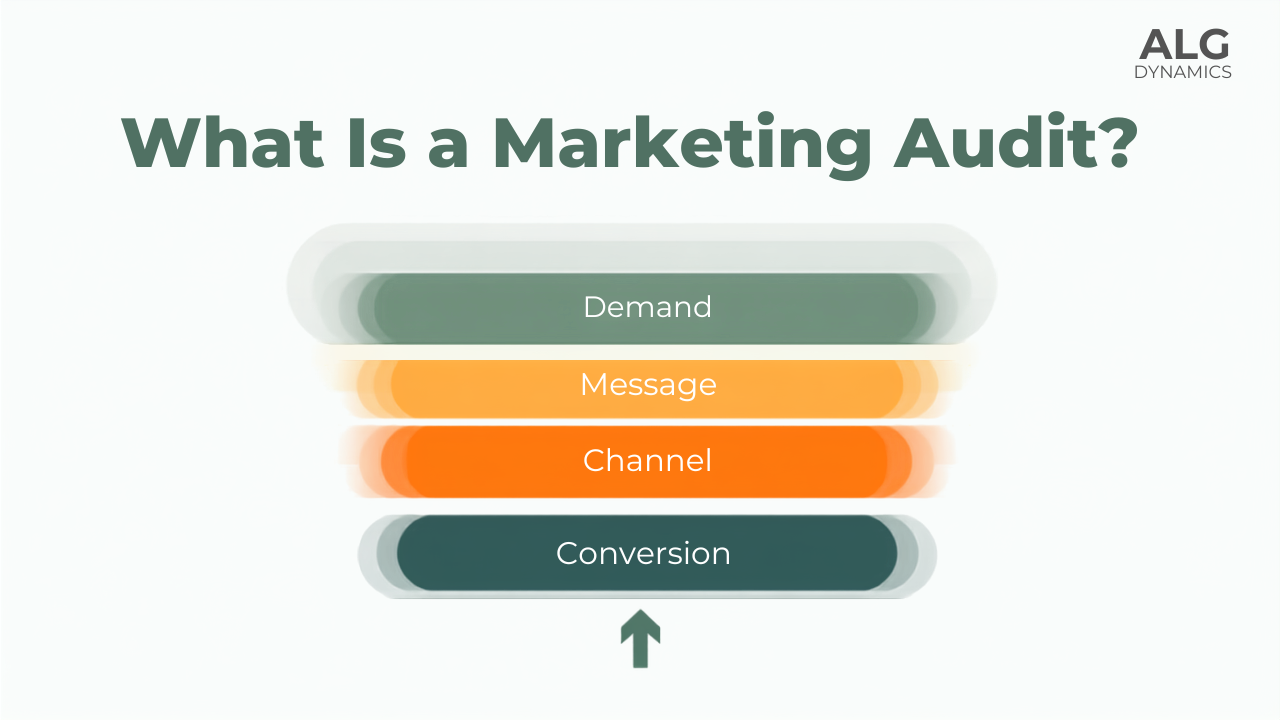
Demand: is anyone actually looking for this?
Before anything else, an audit checks whether the market you are targeting actually wants what you are selling, at the volume you need, in the way you are describing it. A business can execute flawlessly and still stall if the demand assumption underneath it was wrong.
Message: does what we say match what they believe?
This layer is where consumer psychology enters directly. An audit checks whether your messaging addresses the belief your buyer actually holds, not the belief you assumed they held when you wrote the homepage. A mismatch here is invisible in analytics. It shows up as traffic with no conversions.
Channel: are we present where the decision happens?
An audit maps where your buyer actually makes the decision to engage, and checks whether you are present there with the right message, not just present somewhere with a generic one. Being active on a channel is not the same as being relevant on it.
Conversion: does the path let them say yes?
The final layer examines whether the mechanical path from interest to action is actually navigable: forms, pricing clarity, friction points, and the gap between what a visitor believes and what they need to believe before they act.
Types of marketing audit
Internal vs. external audit
An internal audit is run by someone inside the business. It is fast and free but structurally limited: positioning problems and internal politics are difficult to see from the inside, because the person auditing is often the person who built what is being audited. An external audit, often called an independent marketing audit or external marketing audit, trades speed and cost for objectivity.
Full audit vs. functional audit
A functional audit examines one channel in isolation, such as email or SEO. A full audit examines all four layers together, because a channel problem often traces back to a message problem that no channel-specific audit would catch.
Digital marketing audit vs. full marketing audit
A digital marketing audit focuses specifically on online channels and digital conversion paths. A full marketing audit includes offline channels, sales process, and pricing strategy as well. Most small businesses only need the digital scope, unless offline channels carry meaningful revenue.
What a marketing audit is NOT
A marketing audit is not an SEO crawl. An SEO crawl checks technical site health and produces a list of fixes, but it cannot tell you whether your messaging is wrong. It is not a performance review of your marketing team's output. And it is not a tool report generated by software with no human judgment applied to what the numbers mean.
A real diagnosis is the alternative to all three. That is what a Marketing Clarity Intensive is built to deliver. See the full scope of what that engagement covers on the Marketing Clarity Intensive page.
When does a business need a marketing audit?
Five signals typically indicate the timing is right. Spend is increasing but results are flat or declining. Leads arrive but rarely convert to customers. The business has pivoted its offer or audience and the marketing has not caught up. Nobody can clearly explain why the current results are what they are. A new marketing hire or agency has inherited a strategy nobody can defend.
Any one of these signals is reason enough to run a diagnostic before spending further.
What a marketing audit cannot tell you
An audit has real limits, and naming them plainly builds more trust than pretending they do not exist. A marketing audit cannot create demand that does not exist. If nobody wants what you are selling, no amount of message or channel correction fixes that. It also cannot fix a product problem. If the product itself does not deliver on its promise, marketing can only accelerate the discovery of that fact, not solve it.
Who performs a marketing audit, and why that changes the findings
The marketing auditor's incentive shapes the findings, every time. A marketing auditor who sells execution services afterward has a structural reason to find problems that match services they sell. An independent auditor with no downstream retainer has no such incentive, and the findings tend to reflect the business rather than a service menu.
This is worth knowing before you request one, not after you receive it.
How a marketing audit works, step by step
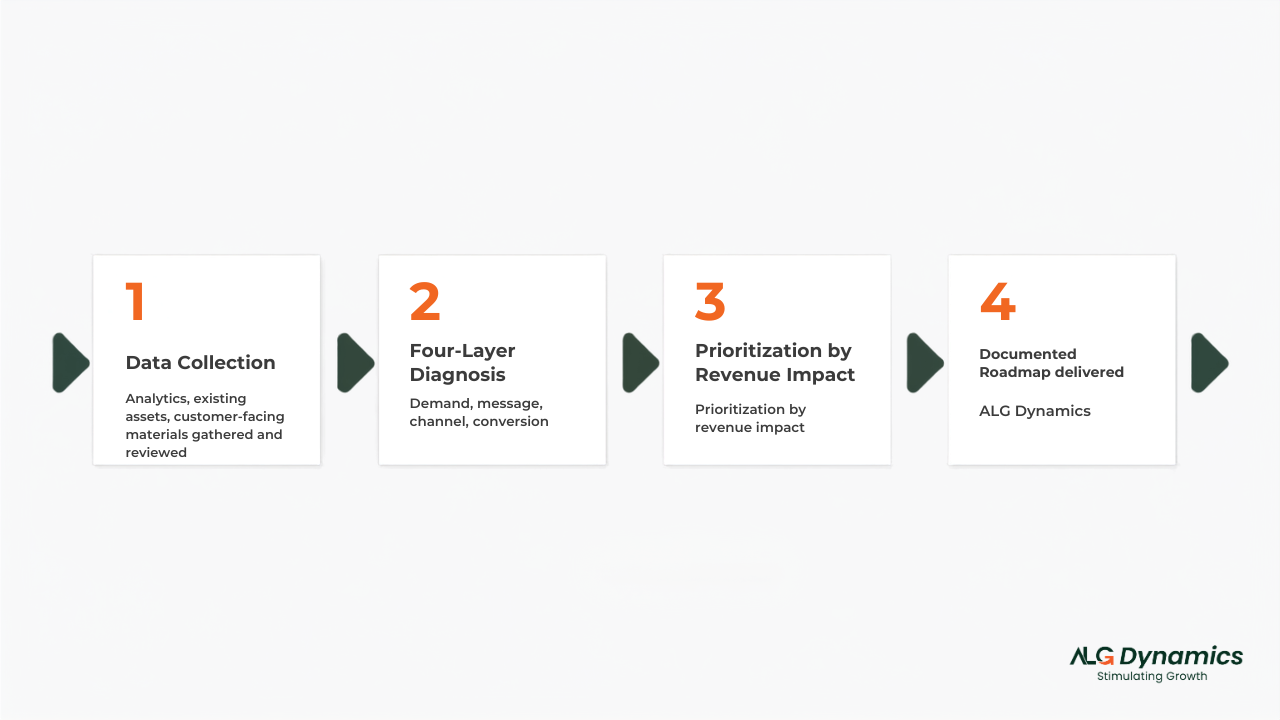
The process typically moves through four stages. First, data collection: analytics, existing assets, and customer-facing materials are gathered and reviewed. Second, the four-layer diagnosis is run against demand, message, channel, and conversion. Third, findings are prioritized by revenue impact, not by ease of implementation. Fourth, the findings are delivered as a documented roadmap, sequenced so the business knows what to address first.
FAQs
What is a marketing audit in simple terms?
A structured check-up that finds where your marketing is losing money and why, rather than simply listing what could theoretically be improved.
What does a marketing audit include?
Demand, message, channel, and conversion, along with a check on data integrity and competitive position.
Marketing audit vs. marketing plan?
An audit diagnoses. A plan prescribes. You cannot write a good plan without the diagnosis underneath it.
Who should conduct a marketing audit?
Internal for a first pass. External when positioning or internal politics are likely to compromise an honest finding.
How long does a marketing audit take?
A day for a self-serve pass using the four-layer framework above. Two to four weeks for a professional diagnostic.
Understanding what a marketing audit actually covers is the first step. See how to run a marketing audit yourself if you want to do a first pass on your own. The next is deciding whether your business needs a self-serve pass or a professional marketing audit service. Either way, the four layers above apply regardless of who runs the audit.
Ready to see what your marketing is actually doing?
Get a structured diagnosis across demand, message, channel, and conversion.
Diagnose My MarketingWhat Is a Marketing Audit? Definition, Types, and What It Actually Finds
The four-layer framework that defines what a marketing audit actually is, and what it isn’t.
Most owners don’t need more marketing. They need to know which part is lying to them.
What is a marketing audit?
A marketing audit is a structured evaluation of your demand, message, channel presence, and conversion path, designed to identify exactly where your marketing is losing money and why.
It exists because most marketing problems are invisible from inside the business that has them.
The 4 layers a marketing audit covers
A real marketing audit examines four distinct layers, and most self-audits only ever check the first two.
Demand: is anyone actually looking for this?
Before anything else, an audit checks whether the market you are targeting actually wants what you are selling, at the volume you need, in the way you are describing it. A business can execute flawlessly and still stall if the demand assumption underneath it was wrong.
Message: does what we say match what they believe?
This layer is where consumer psychology enters directly. An audit checks whether your messaging addresses the belief your buyer actually holds, not the belief you assumed they held when you wrote the homepage. A mismatch here is invisible in analytics. It shows up as traffic with no conversions.
Channel: are we present where the decision happens?
An audit maps where your buyer actually makes the decision to engage, and checks whether you are present there with the right message, not just present somewhere with a generic one. Being active on a channel is not the same as being relevant on it.
Conversion: does the path let them say yes?
The final layer examines whether the mechanical path from interest to action is actually navigable: forms, pricing clarity, friction points, and the gap between what a visitor believes and what they need to believe before they act.
Types of marketing audit
Internal vs. external audit
An internal audit is run by someone inside the business. It is fast and free but structurally limited: positioning problems and internal politics are difficult to see from the inside, because the person auditing is often the person who built what is being audited. An external audit trades speed and cost for objectivity.
Full audit vs. functional audit
A functional audit examines one channel in isolation, such as email or SEO. A full audit examines all four layers together, because a channel problem often traces back to a message problem that no channel-specific audit would catch.
Digital marketing audit vs. full marketing audit
A digital marketing audit focuses specifically on online channels and digital conversion paths. A full marketing audit includes offline channels, sales process, and pricing strategy as well. Most small businesses only need the digital scope, unless offline channels carry meaningful revenue.
What a marketing audit is NOT
A marketing audit is not an SEO crawl. An SEO crawl checks technical site health and produces a list of fixes, but it cannot tell you whether your messaging is wrong. It is not a performance review of your marketing team’s output. And it is not a tool report generated by software with no human judgment applied to what the numbers mean.
A real diagnosis is the alternative to all three. That is what a Marketing Clarity Intensive is built to deliver. See the full scope of what that engagement covers on the Marketing Clarity Intensive page.
When does a business need a marketing audit?
Five signals typically indicate the timing is right. Spend is increasing but results are flat or declining. Leads arrive but rarely convert to customers. The business has pivoted its offer or audience and the marketing has not caught up. Nobody can clearly explain why the current results are what they are. A new marketing hire or agency has inherited a strategy nobody can defend.
Any one of these signals is reason enough to run a diagnostic before spending further.
What a marketing audit cannot tell you
An audit has real limits, and naming them plainly builds more trust than pretending they do not exist. A marketing audit cannot create demand that does not exist. If nobody wants what you are selling, no amount of message or channel correction fixes that. It also cannot fix a product problem. If the product itself does not deliver on its promise, marketing can only accelerate the discovery of that fact, not solve it.
Who performs a marketing audit, and why that changes the findings
The auditor’s incentive shapes the findings, every time. An auditor who sells execution services afterward has a structural reason to find problems that match services they sell. An independent auditor with no downstream retainer has no such incentive, and the findings tend to reflect the business rather than a service menu.
This is worth knowing before you request one, not after you receive it.
How a marketing audit works, step by step
The process typically moves through four stages. First, data collection: analytics, existing assets, and customer-facing materials are gathered and reviewed. Second, the four-layer diagnosis is run against demand, message, channel, and conversion. Third, findings are prioritized by revenue impact, not by ease of implementation. Fourth, the findings are delivered as a documented roadmap, sequenced so the business knows what to address first.
FAQs
What is a marketing audit in simple terms?
A structured check-up that finds where your marketing is losing money and why, rather than simply listing what could theoretically be improved.
What is included in a marketing audit?
Demand, message, channel, and conversion, along with a check on data integrity and competitive position.
Marketing audit vs. marketing plan?
An audit diagnoses. A plan prescribes. You cannot write a good plan without the diagnosis underneath it.
Who should conduct a marketing audit?
Internal for a first pass. External when positioning or internal politics are likely to compromise an honest finding.
How long does a marketing audit take?
A day for a self-serve pass using the four-layer framework above. Two to four weeks for a professional diagnostic.
Understanding what a marketing audit actually covers is the first step. See how to run a marketing audit yourself if you want to do a first pass on your own. The next is deciding whether your business needs a self-serve pass or a professional marketing audit service. Either way, the four layers above apply regardless of who runs the audit.
Ready to see what your marketing is actually doing?
Get a structured diagnosis across demand, message, channel, and conversion.
Diagnose My MarketingCommon misconceptions about what a marketing audit is
The most common misconception is that a marketing audit is the same as a marketing report. A report describes what happened. What is a marketing audit, then? It is a structured evaluation of why it happened, and whether the strategy behind it still holds up.
Another misconception is scope. People ask what is a marketing audit and expect a single deliverable, when in practice it spans channels, message, and measurement together, because problems in one area often originate in another.
The American Marketing Association frames strategy review in similar terms: a periodic, structured look at whether current activity still serves the underlying objective. That is the same standard a useful marketing audit is held to.
If you are still asking what is a marketing audit after reading a dozen agency blog posts, that is not a knowledge gap, it is a definitional problem: most of those posts describe a checklist, not a diagnosis. What is a marketing audit worth doing? One that tells you the root cause, not just the symptom list.
To recap what is a marketing audit in one line: it is the structured answer to why growth stalled, built from evidence across message, channels, funnel, and measurement, not a single dashboard export.
One more way to answer what is a marketing audit: it is the difference between guessing why revenue slowed and knowing. Teams that skip it keep optimizing the wrong layer, because without a real marketing audit, the actual bottleneck stays invisible.
Recommended next steps
Try the free audit worksheet • Understand professional audit deliverables • Get a structured marketing diagnosis