


B2B Marketing Audit: How to Diagnose a Pipeline That Stalled
July 21, 2026
What Is a Marketing Audit? Definition, Types, and What It Actually Finds
August 5, 2026
How to Choose a Digital Marketing Audit Company (7 Questions That Filter Out the Pitch)
Seven questions that separate a real diagnostic from a sales pitch dressed as an audit.
You requested three audits. Two came back as slide decks recommending a retainer. The third came back as a document you could actually use, whether or not you hired anyone.
That difference is not luck. It is structural, and once you can see it, you can test for it before you request the fourth audit.
A digital marketing audit company evaluates your demand, positioning, channels, and conversion path, then hands you a prioritized diagnosis of what is broken and why. The audit itself should be a standalone deliverable, not a preamble to a sales call.
Most companies selling audits are not built to deliver that. They are built to close retainers, and the audit is the opening move.
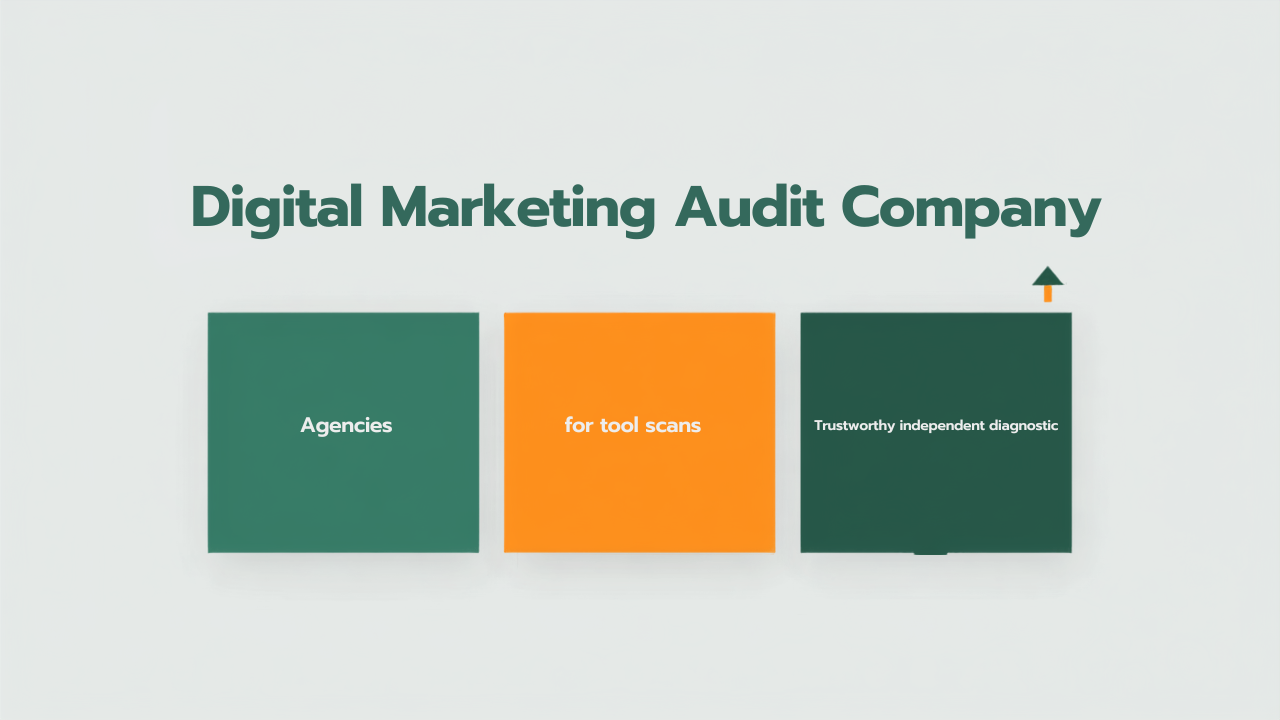
The three types of digital marketing audit company
Every company offering to audit your marketing falls into one of three categories, and the category determines what the audit will conclude before a single account gets reviewed.
The agency that audits (and always finds work for itself)
An agency that sells execution services almost always structures its audit to justify the services it sells. This is not dishonesty. It is incentive. If the agency runs paid ads, the audit will find ad account problems. If it does content, the audit will find content gaps. The audit reflects the agency's service menu more than your business.
The tool company that calls a scan an audit
A second category runs your domain through a software crawler and packages the output as an audit. These reports are useful for what they are: technical scans of site speed, broken links, and on-page SEO basics. They are not a diagnosis of why your marketing is not converting, because the tool cannot read your positioning, your messaging, or your buyer's psychology. It reads code.
The independent diagnostic (no downstream execution incentive)
The third category is structurally different. An independent auditor with no execution retainer to sell has no incentive to find problems that happen to match a service they offer. The findings are shaped by what is actually broken, not by what is billable afterward. This is the category worth paying for directly.
The 7 questions that filter out a sales pitch
Ask these before you sign anything, and pay attention to how directly each one gets answered.
- Will you recommend we stop something, not just add something?
- Do you talk to our customers, or only our analytics?
- Is the audit priced separately from execution?
- Who owns the raw data and findings once the engagement ends?
- What is your policy if the audit finds nothing significant?
- Will you name what you cannot diagnose from the outside?
- Who actually performs the audit, and what is their background?
A vendor that answers all seven without hedging is rare. That rarity is the point.
The incentive test: read the engagement structure, not the deck
Here is the test most buyers skip. Before you read a single slide, read the engagement structure. If the audit is free and the retainer that follows is not, you already know, structurally, what the audit is going to conclude.
This is not a claim about any individual auditor's honesty. It is a claim about incentive design. A free audit that leads into paid execution has to justify its own existence by finding something worth fixing, and the something has to be a thing the agency sells. Read the pricing page before you read the findings page. It tells you more.
What a real audit deliverable contains
A finished, professional audit is not a slide deck with a call-to-action at the end. It contains a prioritized diagnosis ranked by revenue impact, not by what is easiest to fix. It contains an evidence trail, meaning you can see what was reviewed and why a conclusion follows from it, not just the conclusion itself. It contains a sequenced roadmap: what to fix first, second, and third, and why that order matters. And it contains an explicit list of what to stop doing, because most audits are generous with additions and silent about subtractions.
If a deliverable is missing the "stop doing" section, ask why. The absence usually means the audit was built to sell more work, not to save you money.
If you want that kind of deliverable without the sales structure behind it, start with a Marketing Clarity Intensive.
Price ranges in 2026 and what drives them
Audit pricing in 2026 spans a wide range because "audit" describes very different depths of work. A tool-generated scan costs little or nothing because a script produced it. A single-channel functional audit, such as an SEO or email audit alone, typically runs in the low thousands and takes one to two weeks. A full strategic diagnostic covering demand, message, channel, and conversion, the kind that changes what you do next, typically runs several thousand dollars and takes two to four weeks, because it requires a person, not a crawler, to read your business.
The price is not the risk. The value cliff between a tool scan and a real diagnostic is the risk, because a cheap scan that gets treated as a strategic answer can send you fixing the wrong thing for months.
Agency vs. independent vs. in-house: honest trade-offs
| Option | Strength | Trade-off |
|---|---|---|
| Agency audit | Fast, often bundled with a pitch you can evaluate immediately | Findings tend to align with the agency's service menu |
| Independent diagnostic | No downstream execution incentive, findings reflect your business | You still need to execute the roadmap somewhere, internally or externally |
| In-house audit | Full context on the business, no cost of an outside engagement | Politics and blind spots are hard to audit from inside, especially positioning |
None of these is universally correct. The choice depends on whether you need a first pass or a strategic reset, and whether internal politics would compromise an honest internal finding.
Red flags checklist
A handful of signals should slow you down before you commit to an audit engagement.
- The audit is free and a sales call is mandatory to see results.
- The findings arrived within 48 hours of a five-minute intake call.
- Every recommendation happens to be a service the company sells.
- The deliverable has no evidence trail, only conclusions.
- Nobody will tell you what a data-integrity check found, if one was even run.
Any single flag is worth a question. More than one is worth walking away.
FAQs
What does a digital marketing audit company do?
It diagnoses demand, message, channel, and conversion, then hands you a prioritized plan ranked by what actually moves revenue.
How much does a digital marketing audit company charge?
Ranges from free tool scans to several thousand dollars for a full strategic diagnostic, with price generally tracking the depth of human analysis involved.
Agency or independent consultant for an audit?
Depends on whether you want a diagnosis or a proposal. An agency audit is often a proposal in disguise. An independent diagnostic has no service menu to justify.
How long does a professional marketing audit take?
A genuine strategic diagnostic typically takes two to four weeks, because it requires a person reviewing your actual business, not a script reviewing your website.
Is a free audit from an agency trustworthy?
Sometimes useful for surface-level findings, but structurally biased toward the agency's own services. Read it, but read the pricing page first.
ALG Dynamics runs the Marketing Clarity Intensive as a standalone paid diagnostic, not a free lead magnet for a retainer. You are not required to continue with ALG afterward for the findings to be usable, and you can see what marketing audit services actually include here. That structure is not a sales tactic. It is the only structure that removes the incentive to find problems that happen to be billable.
Ready for a diagnosis you can actually trust?
Get a structured, independent audit built to find what a sales-driven scan will not.
Get Marketing ClarityHow to Choose a Digital Marketing Audit Company (7 Questions That Filter Out the Pitch)
Seven questions that separate a real diagnostic from a sales pitch dressed as an audit.
You requested three audits. Two came back as slide decks recommending a retainer. The third came back as a document you could actually use, whether or not you hired anyone.
That difference is not luck. It is structural, and once you can see it, you can test for it before you request the fourth audit.
A digital marketing audit company evaluates your demand, positioning, channels, and conversion path, then hands you a prioritized diagnosis of what is broken and why. The audit itself should be a standalone deliverable, not a preamble to a sales call.
Most companies selling audits are not built to deliver that. They are built to close retainers, and the audit is the opening move.
The three types of digital marketing audit company
Every company offering to audit your marketing falls into one of three categories, and the category determines what the audit will conclude before a single account gets reviewed.
The agency that audits (and always finds work for itself)
An agency that sells execution services almost always structures its audit to justify the services it sells. This is not dishonesty. It is incentive. If the agency runs paid ads, the audit will find ad account problems. If it does content, the audit will find content gaps. The audit reflects the agency’s service menu more than your business.
The tool company that calls a scan an audit
A second category runs your domain through a software crawler and packages the output as an audit. These reports are useful for what they are: technical scans of site speed, broken links, and on-page SEO basics. They are not a diagnosis of why your marketing is not converting, because the tool cannot read your positioning, your messaging, or your buyer’s psychology. It reads code.
The independent diagnostic (no downstream execution incentive)
The third category is structurally different. An independent auditor with no execution retainer to sell has no incentive to find problems that happen to match a service they offer. The findings are shaped by what is actually broken, not by what is billable afterward. This is the category worth paying for directly.
The 7 questions that filter out a sales pitch
Ask these before you sign anything, and pay attention to how directly each one gets answered.
- Will you recommend we stop something, not just add something?
- Do you talk to our customers, or only our analytics?
- Is the audit priced separately from execution?
- Who owns the raw data and findings once the engagement ends?
- What is your policy if the audit finds nothing significant?
- Will you name what you cannot diagnose from the outside?
- Who actually performs the audit, and what is their background?
A vendor that answers all seven without hedging is rare. That rarity is the point.
The incentive test: read the engagement structure, not the deck
Here is the test most buyers skip. Before you read a single slide, read the engagement structure. If the audit is free and the retainer that follows is not, you already know, structurally, what the audit is going to conclude.
This is not a claim about any individual auditor’s honesty. It is a claim about incentive design. A free audit that leads into paid execution has to justify its own existence by finding something worth fixing, and the something has to be a thing the agency sells. Read the pricing page before you read the findings page. It tells you more.
What a real audit deliverable contains
A finished, professional audit is not a slide deck with a call-to-action at the end. It contains a prioritized diagnosis ranked by revenue impact, not by what is easiest to fix. It contains an evidence trail, meaning you can see what was reviewed and why a conclusion follows from it, not just the conclusion itself. It contains a sequenced roadmap: what to fix first, second, and third, and why that order matters. And it contains an explicit list of what to stop doing, because most audits are generous with additions and silent about subtractions.
If a deliverable is missing the “stop doing” section, ask why. The absence usually means the audit was built to sell more work, not to save you money.
If you want that kind of deliverable without the sales structure behind it, start with a Marketing Clarity Intensive.
Price ranges in 2026 and what drives them
Audit pricing in 2026 spans a wide range because “audit” describes very different depths of work. A tool-generated scan costs little or nothing because a script produced it. A single-channel functional audit, such as an SEO or email audit alone, typically runs in the low thousands and takes one to two weeks. A full strategic diagnostic covering demand, message, channel, and conversion, the kind that changes what you do next, typically runs several thousand dollars and takes two to four weeks, because it requires a person, not a crawler, to read your business.
The price is not the risk. The value cliff between a tool scan and a real diagnostic is the risk, because a cheap scan that gets treated as a strategic answer can send you fixing the wrong thing for months.
Agency vs. independent vs. in-house: honest trade-offs
| Option | Strength | Trade-off |
|---|---|---|
| Agency audit | Fast, often bundled with a pitch you can evaluate immediately | Findings tend to align with the agency’s service menu |
| Independent diagnostic | No downstream execution incentive, findings reflect your business | You still need to execute the roadmap somewhere, internally or externally |
| In-house audit | Full context on the business, no cost of an outside engagement | Politics and blind spots are hard to audit from inside, especially positioning |
None of these is universally correct. The choice depends on whether you need a first pass or a strategic reset, and whether internal politics would compromise an honest internal finding.
Red flags checklist
A handful of signals should slow you down before you commit to an audit engagement.
- The audit is free and a sales call is mandatory to see results.
- The findings arrived within 48 hours of a five-minute intake call.
- Every recommendation happens to be a service the company sells.
- The deliverable has no evidence trail, only conclusions.
- Nobody will tell you what a data-integrity check found, if one was even run.
Any single flag is worth a question. More than one is worth walking away.
FAQs
What does a digital marketing audit company do?
It diagnoses demand, message, channel, and conversion, then hands you a prioritized plan ranked by what actually moves revenue.
How much does a digital marketing audit company charge?
Ranges from free tool scans to several thousand dollars for a full strategic diagnostic, with price generally tracking the depth of human analysis involved.
Agency or independent consultant for an audit?
Depends on whether you want a diagnosis or a proposal. An agency audit is often a proposal in disguise. An independent diagnostic has no service menu to justify.
How long does a professional marketing audit take?
A genuine strategic diagnostic typically takes two to four weeks, because it requires a person reviewing your actual business, not a script reviewing your website.
Is a free audit from an agency trustworthy?
Sometimes useful for surface-level findings, but structurally biased toward the agency’s own services. Read it, but read the pricing page first.
ALG Dynamics runs the Marketing Clarity Intensive as a standalone paid diagnostic, not a free lead magnet for a retainer. You are not required to continue with ALG afterward for the findings to be usable, and you can see what marketing audit services actually include here. That structure is not a sales tactic. It is the only structure that removes the incentive to find problems that happen to be billable.
Ready for a diagnosis you can actually trust?
Get a structured, independent audit built to find what a sales-driven scan will not.
Get Marketing ClarityRed flags when vetting a digital marketing audit company
A digital marketing audit company that promises a fixed list of findings before it has seen your data is selling a template, not an audit. The same is true of a digital marketing audit company that cannot name the specific hypothesis it is testing in your account.
Independent guidance from the Federal Trade Commission’s business guidance on marketing claims is a useful backdrop here: a credible digital marketing audit company should be able to substantiate every claim it makes about your account, not just describe a general process.
The right digital marketing audit company treats the first conversation as diagnostic, not promotional. If the call feels like a pitch instead of a Q&A about your numbers, that is the clearest signal to keep looking.
Recommended next steps
Compare professional marketing audit services • Review the diagnostic approach • Contact ALG Dynamics