


What Is a Marketing Audit? Definition, Types, and What It Actually Finds
August 5, 2026
Content Marketing Audit: How to Find the 20% of Content Doing 80% of the Work
August 10, 2026
Website Marketing Audit: Why Traffic Arrives and Nobody Converts
A 12-point framework for finding out why visitors leave without converting.
The traffic is real. The ads are working. People are landing on your site every day, and almost none of them become customers.
That gap is rarely an SEO problem, even though most audits treat it like one.
A website marketing audit examines whether your site persuades a visitor to act, not just whether it ranks or loads quickly. It reviews message clarity, proof, objection handling, and the mechanical path to conversion, then identifies exactly where visitors form doubt and leave.
The difference between an SEO audit and a website marketing audit
SEO gets a visitor to your site. Marketing decides whether they stay, believe you, and act. Most audits available online are SEO audits wearing a marketing hat: they check page speed, meta tags, and broken links, then call the report a marketing audit because it touched your website.
Those checks matter. They are not the reason a visitor with genuine intent leaves without converting. That reason almost always lives in message and proof, not in code.
The 12-point website marketing audit
Run these twelve checks in order, because each one assumes the visitor survived the one before it.
- The 5-second clarity test: what do you do, for whom, and why you
- Problem-before-solution ordering
- Proof density: is there evidence within one scroll?
- Objection handling above the fold
- Single primary CTA per page
- Form friction (every field costs conversions)
- Trust signals placement
- Pricing transparency
- Mobile decision path
- Page speed, in proportion
- Content-to-intent match by landing page
- Exit points: where they leave and what preceded it
The 5-second clarity test asks whether a stranger can tell what you do, for whom, and why you within five seconds of landing. Most sites fail this, burying the answer under a headline optimized for cleverness instead of clarity. Problem-before-solution ordering checks whether the page names the visitor's problem before pitching the fix, because a solution presented before the problem is named reads as generic to someone who has not yet recognized themselves in the copy.
Proof density asks whether there is evidence within one scroll: a number, a name, a specific result, something concrete rather than a claim. Objection handling above the fold checks whether the page addresses the visitor's most likely hesitation before they have to scroll to find reassurance. A single primary CTA per page keeps the decision simple; a page offering five different actions is a page asking the visitor to do the deciding work the page should be doing.
Form friction counts every field on your lead form, because each additional field is a small tax on conversion, and most forms ask for more than the first conversation requires. Trust signals placement checks whether credibility markers appear near the decision point, not buried in a footer nobody scrolls to. Pricing transparency asks whether cost information is available or at least directionally clear, since ambiguity here reads as evasion to a skeptical buyer.
Mobile decision path verifies that the same persuasion sequence works on a phone, where thumbs and small screens change what gets read. Page speed matters, but in proportion. It is rarely the binding constraint once a site loads in a few seconds, and treating it as the top priority often means avoiding a harder message problem underneath. Content-to-intent match by landing page checks whether each page's content actually matches what the visitor expected when they clicked to arrive there. Exit points close the audit: where visitors leave, and what they saw immediately before leaving, tells you more than almost any other single metric on the page.
The belief audit: what a visitor must believe to convert
Here is the framework that most website audits never mention, because it did not come from an analytics dashboard. It came from consumer psychology.
Before a visitor converts, they must hold five beliefs, in sequence. I have this problem. It is worth fixing. This can fix it. This can fix it for me specifically, not for a generic version of my situation. The risk of trying is acceptable.
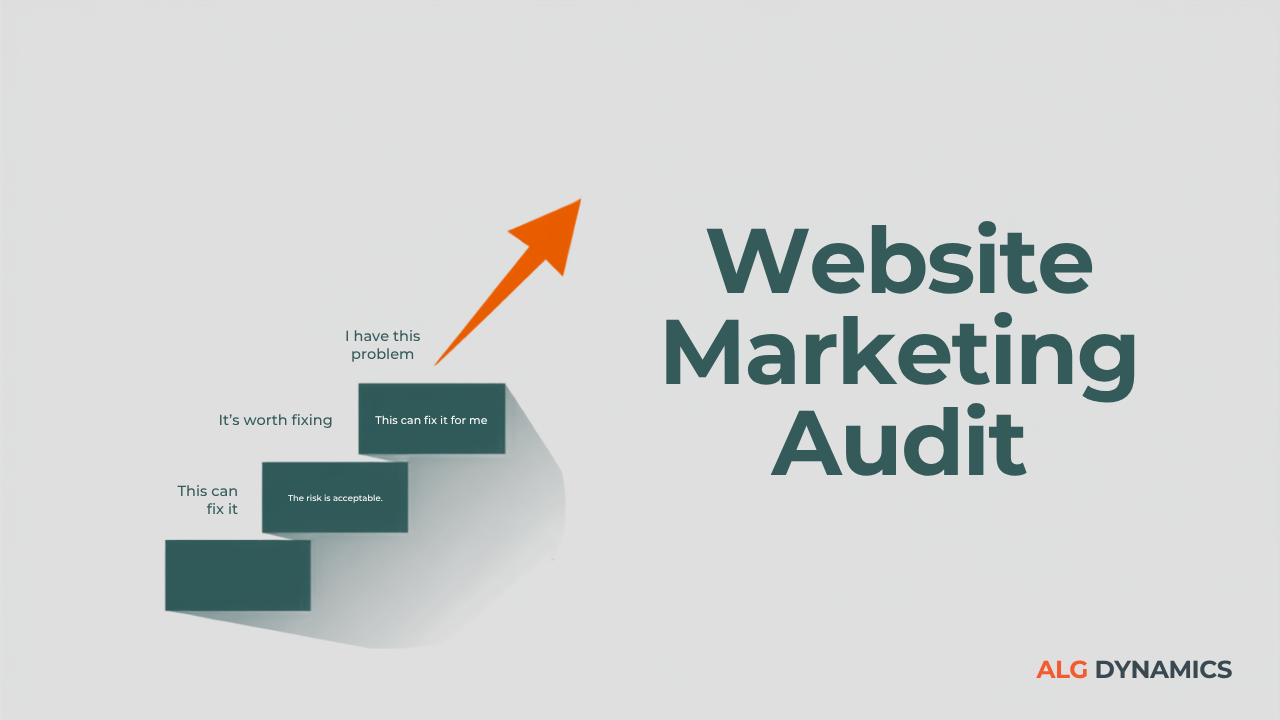
Audit your site against each belief individually, not against the page as a whole. A page can be beautifully designed and still fail belief three, because it explains the mechanism without ever proving it works. It can pass belief three and fail belief four, because the proof shown belongs to a different kind of customer than the one reading it. Naming the specific belief that fails is more useful than a general sense that "something isn't working."
Reading session recordings like a psychologist, not an analyst
Session recordings are usually reviewed for technical bugs. Read differently, they reveal belief failure in real time.
Hesitation before a CTA click often signals belief four or five failing, not confusion about where to click. Scroll-back to a section the visitor already passed usually means they are searching for proof they expected and did not find the first time. Rage-clicking on a non-interactive element is not a UX bug report. It is frustration with a page that promised something the visitor cannot locate.
Watch ten recordings with the five beliefs in mind, and patterns emerge that no heatmap tool will label for you.
Prioritizing website fixes by revenue impact
Not every finding deserves equal attention. Rank fixes by where in the funnel they sit and how many visitors are affected at that point, not by which fix is easiest to implement this week.
A belief-three failure on your highest-traffic landing page outranks a minor form-friction issue on a page three clicks deep. Fix the leak closest to the top of the funnel first, because every visitor who drops there never reaches the fixes further down.
FAQs
What is a website marketing audit?
A review of whether your site persuades a visitor to act, not just whether it ranks in search or loads quickly.
How is it different from an SEO audit?
An SEO audit evaluates traffic acquisition. A marketing audit evaluates conversion and message, once the visitor has already arrived.
What should I check first on a low-converting website?
The 5-second clarity test. Most underperforming sites fail here before any other issue becomes relevant.
How often should I audit my website?
Every six months at minimum, and again after any redesign, offer change, or significant shift in who you are targeting.
Does page speed really affect conversions?
Yes, but it is rarely the binding constraint once a site loads reasonably fast. Treat it in proportion rather than as the first place to look.
Most underperforming websites were not built badly. Run the same 9-point audit against your broader marketing and you will usually find the pattern repeats. They were built by people doing their best without a model of what a visitor needs to believe before they buy. The belief audit above is that model, and it takes about an hour to run against your own site.
Ready to find where your site loses visitors?
Get a structured audit of message, proof, and conversion path, not just a speed score.
Get Marketing ClarityWebsite Marketing Audit: Why Traffic Arrives and Nobody Converts
A 12-point framework for finding out why visitors leave without converting.
The traffic is real. The ads are working. People are landing on your site every day, and almost none of them become customers.
That gap is rarely an SEO problem, even though most audits treat it like one.
A website marketing audit examines whether your site persuades a visitor to act, not just whether it ranks or loads quickly. It reviews message clarity, proof, objection handling, and the mechanical path to conversion, then identifies exactly where visitors form doubt and leave.
The difference between an SEO audit and a website marketing audit
SEO gets a visitor to your site. Marketing decides whether they stay, believe you, and act. Most audits available online are SEO audits wearing a marketing hat: they check page speed, meta tags, and broken links, then call the report a marketing audit because it touched your website.
Those checks matter. They are not the reason a visitor with genuine intent leaves without converting. That reason almost always lives in message and proof, not in code.
The 12-point website marketing audit
Run these twelve checks in order, because each one assumes the visitor survived the one before it.
- The 5-second clarity test: what do you do, for whom, and why you
- Problem-before-solution ordering
- Proof density: is there evidence within one scroll?
- Objection handling above the fold
- Single primary CTA per page
- Form friction (every field costs conversions)
- Trust signals placement
- Pricing transparency
- Mobile decision path
- Page speed, in proportion
- Content-to-intent match by landing page
- Exit points: where they leave and what preceded it
The 5-second clarity test asks whether a stranger can tell what you do, for whom, and why you within five seconds of landing. Most sites fail this, burying the answer under a headline optimized for cleverness instead of clarity. Problem-before-solution ordering checks whether the page names the visitor’s problem before pitching the fix, because a solution presented before the problem is named reads as generic to someone who has not yet recognized themselves in the copy.
Proof density asks whether there is evidence within one scroll: a number, a name, a specific result, something concrete rather than a claim. Objection handling above the fold checks whether the page addresses the visitor’s most likely hesitation before they have to scroll to find reassurance. A single primary CTA per page keeps the decision simple; a page offering five different actions is a page asking the visitor to do the deciding work the page should be doing.
Form friction counts every field on your lead form, because each additional field is a small tax on conversion, and most forms ask for more than the first conversation requires. Trust signals placement checks whether credibility markers appear near the decision point, not buried in a footer nobody scrolls to. Pricing transparency asks whether cost information is available or at least directionally clear, since ambiguity here reads as evasion to a skeptical buyer.
Mobile decision path verifies that the same persuasion sequence works on a phone, where thumbs and small screens change what gets read. Page speed matters, but in proportion. It is rarely the binding constraint once a site loads in a few seconds, and treating it as the top priority often means avoiding a harder message problem underneath. Content-to-intent match by landing page checks whether each page’s content actually matches what the visitor expected when they clicked to arrive there. Exit points close the audit: where visitors leave, and what they saw immediately before leaving, tells you more than almost any other single metric on the page.
The belief audit: what a visitor must believe to convert
Here is the framework that most website audits never mention, because it did not come from an analytics dashboard. It came from consumer psychology.
Before a visitor converts, they must hold five beliefs, in sequence. I have this problem. It is worth fixing. This can fix it. This can fix it for me specifically, not for a generic version of my situation. The risk of trying is acceptable.
Audit your site against each belief individually, not against the page as a whole. A page can be beautifully designed and still fail belief three, because it explains the mechanism without ever proving it works. It can pass belief three and fail belief four, because the proof shown belongs to a different kind of customer than the one reading it. Naming the specific belief that fails is more useful than a general sense that “something isn’t working.”
Reading session recordings like a psychologist, not an analyst
Session recordings are usually reviewed for technical bugs. Read differently, they reveal belief failure in real time.
Hesitation before a CTA click often signals belief four or five failing, not confusion about where to click. Scroll-back to a section the visitor already passed usually means they are searching for proof they expected and did not find the first time. Rage-clicking on a non-interactive element is not a UX bug report. It is frustration with a page that promised something the visitor cannot locate.
Watch ten recordings with the five beliefs in mind, and patterns emerge that no heatmap tool will label for you.
Prioritizing website fixes by revenue impact
Not every finding deserves equal attention. Rank fixes by where in the funnel they sit and how many visitors are affected at that point, not by which fix is easiest to implement this week.
A belief-three failure on your highest-traffic landing page outranks a minor form-friction issue on a page three clicks deep. Fix the leak closest to the top of the funnel first, because every visitor who drops there never reaches the fixes further down.
FAQs
What is a website marketing audit?
A review of whether your site persuades a visitor to act, not just whether it ranks in search or loads quickly.
How is it different from an SEO audit?
An SEO audit evaluates traffic acquisition. A marketing audit evaluates conversion and message, once the visitor has already arrived.
What should I check first on a low-converting website?
The 5-second clarity test. Most underperforming sites fail here before any other issue becomes relevant.
How often should I audit my website?
Every six months at minimum, and again after any redesign, offer change, or significant shift in who you are targeting.
Does page speed really affect conversions?
Yes, but it is rarely the binding constraint once a site loads reasonably fast. Treat it in proportion rather than as the first place to look.
Most underperforming websites were not built badly. Run the same 9-point audit against your broader marketing and you will usually find the pattern repeats. They were built by people doing their best without a model of what a visitor needs to believe before they buy. The belief audit above is that model, and it takes about an hour to run against your own site.
Ready to find where your site loses visitors?
Get a structured audit of message, proof, and conversion path, not just a speed score.
Get Marketing ClarityCommon mistakes in a website marketing audit
The most common mistake in a website marketing audit is stopping at analytics. Session recordings and heatmaps show what people did, but a website marketing audit that skips message clarity will miss why they left. The second mistake is auditing every page equally instead of starting with the pages that carry the most traffic and the most intent.
Independent usability research from the Nielsen Norman Group backs up what most website marketing audit findings show in practice: clarity and trust cues move conversion more reliably than cosmetic redesigns.
A website marketing audit is not a one-time fix. Revisit the same framework every time you change a major page, launch a new offer, or notice a shift in traffic quality.
Recommended next steps
Audit the content supporting your website • Run the free marketing audit worksheet • Diagnose the conversion problem