



AI Search Optimization: How to Get Cited by ChatGPT, Gemini, and Google AI Overviews
July 26, 2025
Email Marketing Audit: The 10-Point Check for Lists That Stopped Converting
July 21, 2026
Small Business Digital Marketing Audit: The 9-Point Check That Finds Where Growth Leaks
A structured, self-serve diagnostic to find exactly where your marketing spend stops converting into revenue.
Your marketing is running. The results are not. You are paying for ads, posting on schedule, sending the emails, and the numbers still sit flat. That gap between activity and outcome is not a mystery. It is a structural signal, and a small business digital marketing audit is how you find where it starts.
A small business digital marketing audit is a structured diagnosis of your demand, message, channel, and conversion layers that identifies exactly where spend and effort stop converting into revenue.
A digital marketing audit is not a report card. It is not a list of tool scores or a spreadsheet of vanity metrics pulled from an SEO crawl. Most small business owners hear "audit" and picture a technical scan of their website. That is one layer of four. The other three, demand, message, and conversion, are where the real leaks usually live, and they are exactly the layers a free tool cannot see.
The 5 signals it's time to audit
Every marketing audit small business owners run for the first time turns up at least one surprise. It is rarely the one they expected. Rising spend paired with flat revenue is the clearest one. If your ad budget climbed this year and your close rate did not, something between click and customer is broken. Traffic without leads is the second: visitors are showing up and leaving without a trace, which usually points to message or conversion path, not channel choice.
The third signal is more subtle. Every channel "kind of works," meaning nothing is failing outright but nothing is compounding either. The fourth is structural: you cannot name your ideal customer's actual decision trigger in one sentence. The fifth is organizational. Nobody reads the reports anymore, because nobody trusts what they mean.
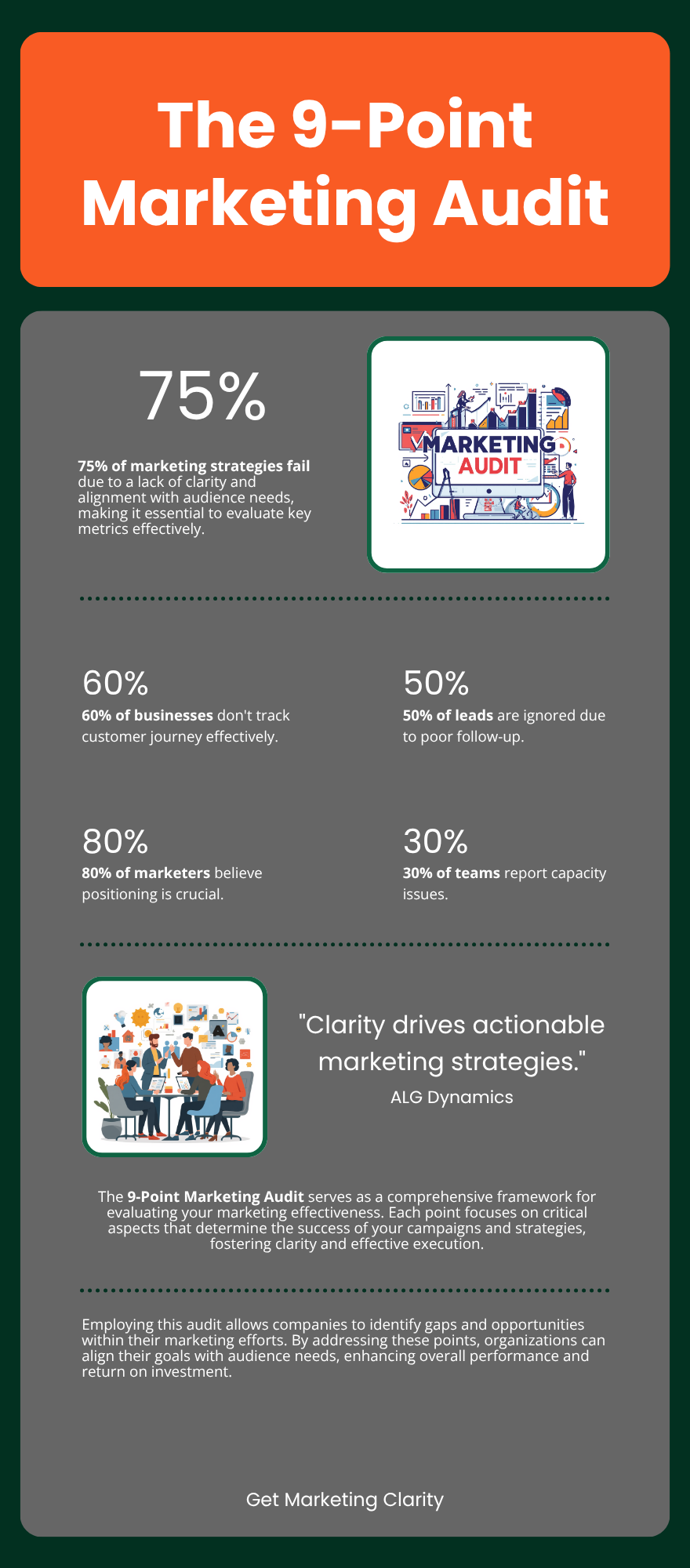
The 9-point small business marketing audit
1. Audience clarity
Can you name the buyer's actual decision trigger, the specific moment or frustration that sends them looking for a solution like yours? Most owners can describe a demographic. Few can describe the trigger. Without it, every other layer of the audit inherits the same blur.
2. Message-market fit
Does your homepage state the problem before it states the solution? Visitors arrive mid-thought, already living the frustration. A homepage that opens with your product instead of their pain forces them to do the translation work themselves, and most will not bother.
3. Channel efficiency
Measure cost per qualified lead by channel, not cost per click. A channel with cheap clicks and unqualified leads is not efficient. It is expensive in a way your dashboard is hiding from you.
4. Website conversion path
Walk your own site as a stranger would. Count the steps between arrival and the action you actually want. Every extra step is a place someone can quietly leave.
5. Content-to-intent mapping
Check whether your content answers the questions your buyers are actually asking at each stage, or whether it answers the questions you find easiest to write about. Those are rarely the same list.
6. Email and lifecycle
Look at what happens after someone gives you their email. A welcome sequence that goes silent, or worse, sends the same generic newsletter to a brand-new lead and a five-year customer, is losing trust it already earned.
7. Data and attribution integrity
Confirm your numbers actually mean what you think they mean. Last-click attribution rewards whichever channel happens to close the deal, even when three other channels did the real persuading upstream.
8. Competitive positioning gap
Name the one claim your competitors make that you cannot credibly counter. If you cannot name it, you have not looked closely enough, and neither has your buyer.
9. Team capability and capacity
Be honest about who is actually executing each layer above, and whether they have the hours to do it well. A strategy nobody has time to run is not a strategy.
For each point, the test is the same: what to check, what "good" looks like, and the single red flag that tells you it is broken.
The psychology layer: why audits find symptoms, not causes
Most audit checklists, the kind published by larger agencies, stop at the tactical list above. They will tell you your bounce rate is high or your subject lines are weak. What they will not tell you is why the fix does not stick.
Here is the distinction that matters: most of what gets labeled a "marketing problem" is actually a decision-friction problem happening inside the buyer's head. Your messaging can be technically correct and still fail, because the buyer has not resolved a private objection your copy never addressed.
This is why a fix can look perfect on paper and change nothing. A business owner rewrites her homepage headline, sharpens the offer, adds social proof, and traffic behavior does not move. The belief barrier, the specific doubt keeping a visitor from acting, was never touched. Friction is not the same as motivation. You can raise motivation all day with better creative and better copy, but if the friction point stays hidden, the audience simply stalls at the same place it always has.
How to score your audit
Rate each of the nine points on a simple 1 to 5 scale: 1 means broken or absent, 5 means this layer is actively compounding growth. Add a one-line note under each score describing the specific evidence, not a gut feeling. A channel scoring a 2 because cost per qualified lead has doubled in six months is a different problem than a channel scoring a 2 because nobody has checked it in a year.
Most owners can build this scoring table in a spreadsheet in under an hour. Nobody in the current top ten search results offers one. That gap is your advantage: a scored audit turns nine subjective impressions into a ranked list you can actually act on.
What to do with the findings: sequencing fixes
Once you have scores, rank each low-scoring point by impact times confidence, divided by effort. Fix the leak before the pump. It does not matter how much traffic you drive if the conversion path underneath it is broken. Chasing more volume into a broken funnel just makes the leak bigger and the invoice higher.
When to DIY vs. bring in an outside diagnostic
You can run this audit yourself, and you should, at least once. The exercise alone will surface things a dashboard never shows you. The honest limit is this: two of the nine points, attribution integrity and positioning gap, are places owners are structurally blind to their own business. You cannot see your own blind spot from inside it, by definition.
If your scoring exercise turns up multiple points stuck at a 2 or lower, or if you finish the audit and still cannot explain your buyer's decision trigger in one sentence, that is the signal to bring in an outside set of eyes.
Common mistakes in a DIY small business digital marketing audit
The most frequent mistake is treating a small business digital marketing audit as a one-time report instead of a recurring habit. Channels and platforms change their rules often enough that a checklist run once a year misses problems that build up quietly in the months between reviews.
A second common mistake is auditing traffic and spend without connecting either one to actual revenue. Google's own guidance on measuring what matters notes that vanity metrics like raw traffic or impressions rarely correlate with business outcomes unless they are tied to a specific conversion event (Google Analytics help: about conversions). A small business digital marketing audit that stops at traffic numbers leaves the real leak unexamined.
The third mistake is skipping the message and positioning layer entirely. Teams often check channel performance and conversion rates but never ask whether the offer itself is clear to a first-time visitor. A structural small business digital marketing audit has to include this step, because no amount of channel optimization fixes a message that does not land.
How often a small business should repeat the audit
Most small businesses get the most value from running a full small business digital marketing audit twice a year, with a lighter monthly check on the handful of metrics that tend to drift fastest, like cost per lead and email list engagement. Businesses in fast-changing categories, or those that just launched a new channel, benefit from a tighter quarterly cadence until performance stabilizes.
Whatever the schedule, the goal of a small business digital marketing audit stays the same: catch the leak while it is still small, before it compounds into a quarter of wasted spend.
What a small business digital marketing audit costs you if you skip it
Every quarter without a small business digital marketing audit is a quarter where the same leak keeps draining budget unnoticed. Owners who run a small business digital marketing audit on a fixed schedule catch drift in cost per lead, email engagement, and landing page conversion long before it shows up as a bad month on the books. A small business digital marketing audit does not need to be elaborate to be useful, but it does need to happen on a schedule you actually keep.
FAQs
What is a small business marketing audit?
A structured 9-point diagnosis of demand, message, channel, and conversion.
How often should a small business audit its marketing?
Twice yearly, plus any time ad spend rises without a matching lift in qualified leads.
How much does a marketing audit cost?
Anywhere from free self-serve checklists to $2,000 to $10,000 for a professional diagnostic. What changes at each tier is depth: free tools catch surface issues, paid diagnostics find positioning and belief-level gaps.
Can I do a marketing audit myself?
Yes, for a first pass. The two points where owners are usually blind to their own business are attribution integrity and the competitive positioning gap.
What's the difference between a marketing audit and an SEO audit?
An SEO audit checks one channel. A marketing audit checks whether that channel should exist in your mix at all.
Small Business Digital Marketing Audit: The 9-Point Check That Finds Where Growth Leaks
A structured, self-serve diagnostic to find exactly where your marketing spend stops converting into revenue.
Your marketing is running. The results are not. You are paying for ads, posting on schedule, sending the emails, and the numbers still sit flat. That gap between activity and outcome is not a mystery. It is a structural signal, and a small business digital marketing audit is how you find where it starts.
A small business digital marketing audit is a structured diagnosis of your demand, message, channel, and conversion layers that identifies exactly where spend and effort stop converting into revenue.
A digital marketing audit is not a report card. It is not a list of tool scores or a spreadsheet of vanity metrics pulled from an SEO crawl. Most small business owners hear “audit” and picture a technical scan of their website. That is one layer of four. The other three, demand, message, and conversion, are where the real leaks usually live, and they are exactly the layers a free tool cannot see.
The 5 signals it’s time to audit
Rising spend paired with flat revenue is the clearest one. If your ad budget climbed this year and your close rate did not, something between click and customer is broken. Traffic without leads is the second: visitors are showing up and leaving without a trace, which usually points to message or conversion path, not channel choice.
The third signal is more subtle. Every channel “kind of works,” meaning nothing is failing outright but nothing is compounding either. The fourth is structural: you cannot name your ideal customer’s actual decision trigger in one sentence. The fifth is organizational. Nobody reads the reports anymore, because nobody trusts what they mean.
The 9-point small business marketing audit
1. Audience clarity
Can you name the buyer’s actual decision trigger, the specific moment or frustration that sends them looking for a solution like yours? Most owners can describe a demographic. Few can describe the trigger. Without it, every other layer of the audit inherits the same blur.
2. Message-market fit
Does your homepage state the problem before it states the solution? Visitors arrive mid-thought, already living the frustration. A homepage that opens with your product instead of their pain forces them to do the translation work themselves, and most will not bother.
3. Channel efficiency
Measure cost per qualified lead by channel, not cost per click. A channel with cheap clicks and unqualified leads is not efficient. It is expensive in a way your dashboard is hiding from you.
4. Website conversion path
Walk your own site as a stranger would. Count the steps between arrival and the action you actually want. Every extra step is a place someone can quietly leave.
5. Content-to-intent mapping
Check whether your content answers the questions your buyers are actually asking at each stage, or whether it answers the questions you find easiest to write about. Those are rarely the same list.
6. Email and lifecycle
Look at what happens after someone gives you their email. A welcome sequence that goes silent, or worse, sends the same generic newsletter to a brand-new lead and a five-year customer, is losing trust it already earned.
7. Data and attribution integrity
Confirm your numbers actually mean what you think they mean. Last-click attribution rewards whichever channel happens to close the deal, even when three other channels did the real persuading upstream.
8. Competitive positioning gap
Name the one claim your competitors make that you cannot credibly counter. If you cannot name it, you have not looked closely enough, and neither has your buyer.
9. Team capability and capacity
Be honest about who is actually executing each layer above, and whether they have the hours to do it well. A strategy nobody has time to run is not a strategy.
For each point, the test is the same: what to check, what “good” looks like, and the single red flag that tells you it is broken.
The psychology layer: why audits find symptoms, not causes
Most audit checklists, the kind published by larger agencies, stop at the tactical list above. They will tell you your bounce rate is high or your subject lines are weak. What they will not tell you is why the fix does not stick.
Here is the distinction that matters: most of what gets labeled a “marketing problem” is actually a decision-friction problem happening inside the buyer’s head. Your messaging can be technically correct and still fail, because the buyer has not resolved a private objection your copy never addressed.
This is why a fix can look perfect on paper and change nothing. A business owner rewrites her homepage headline, sharpens the offer, adds social proof, and traffic behavior does not move. The belief barrier, the specific doubt keeping a visitor from acting, was never touched. Friction is not the same as motivation. You can raise motivation all day with better creative and better copy, but if the friction point stays hidden, the audience simply stalls at the same place it always has.
How to score your audit
Rate each of the nine points on a simple 1 to 5 scale: 1 means broken or absent, 5 means this layer is actively compounding growth. Add a one-line note under each score describing the specific evidence, not a gut feeling. A channel scoring a 2 because cost per qualified lead has doubled in six months is a different problem than a channel scoring a 2 because nobody has checked it in a year.
Most owners can build this scoring table in a spreadsheet in under an hour. Nobody in the current top ten search results offers one. That gap is your advantage: a scored audit turns nine subjective impressions into a ranked list you can actually act on.
What to do with the findings: sequencing fixes
Once you have scores, rank each low-scoring point by impact times confidence, divided by effort. Fix the leak before the pump. It does not matter how much traffic you drive if the conversion path underneath it is broken. Chasing more volume into a broken funnel just makes the leak bigger and the invoice higher.
When to DIY vs. bring in an outside diagnostic
You can run this audit yourself, and you should, at least once. The exercise alone will surface things a dashboard never shows you. The honest limit is this: two of the nine points, attribution integrity and positioning gap, are places owners are structurally blind to their own business. You cannot see your own blind spot from inside it, by definition.
If your scoring exercise turns up multiple points stuck at a 2 or lower, or if you finish the audit and still cannot explain your buyer’s decision trigger in one sentence, that is the signal to bring in an outside set of eyes.
Common mistakes in a DIY small business digital marketing audit
The most frequent mistake is treating a small business digital marketing audit as a one-time report instead of a recurring habit. Channels and platforms change their rules often enough that a checklist run once a year misses problems that build up quietly in the months between reviews.
A second common mistake is auditing traffic and spend without connecting either one to actual revenue. Google’s own guidance on measuring what matters notes that vanity metrics like raw traffic or impressions rarely correlate with business outcomes unless they are tied to a specific conversion event (Google Analytics help: about conversions). A small business digital marketing audit that stops at traffic numbers leaves the real leak unexamined.
The third mistake is skipping the message and positioning layer entirely. Teams often check channel performance and conversion rates but never ask whether the offer itself is clear to a first-time visitor. A structural small business digital marketing audit has to include this step, because no amount of channel optimization fixes a message that does not land.
How often a small business should repeat the audit
Most small businesses get the most value from running a full small business digital marketing audit twice a year, with a lighter monthly check on the handful of metrics that tend to drift fastest, like cost per lead and email list engagement. Businesses in fast-changing categories, or those that just launched a new channel, benefit from a tighter quarterly cadence until performance stabilizes.
Whatever the schedule, the goal of a small business digital marketing audit stays the same: catch the leak while it is still small, before it compounds into a quarter of wasted spend.
What a small business digital marketing audit costs you if you skip it
Every quarter without a small business digital marketing audit is a quarter where the same leak keeps draining budget unnoticed. Owners who run a small business digital marketing audit on a fixed schedule catch drift in cost per lead, email engagement, and landing page conversion long before it shows up as a bad month on the books. A small business digital marketing audit does not need to be elaborate to be useful, but it does need to happen on a schedule you actually keep.
FAQs
What is a small business marketing audit?
A structured 9-point diagnosis of demand, message, channel, and conversion.
How often should a small business audit its marketing?
Twice yearly, plus any time ad spend rises without a matching lift in qualified leads.
How much does a marketing audit cost?
Anywhere from free self-serve checklists to $2,000 to $10,000 for a professional diagnostic. What changes at each tier is depth: free tools catch surface issues, paid diagnostics find positioning and belief-level gaps.
Can I do a marketing audit myself?
Yes, for a first pass. The two points where owners are usually blind to their own business are attribution integrity and the competitive positioning gap.
What’s the difference between a marketing audit and an SEO audit?
An SEO audit checks one channel. A marketing audit checks whether that channel should exist in your mix at all.
Recommended next steps
Use the free marketing audit worksheet • Learn how a full marketing audit works • Get a professional marketing diagnosis