


B2B Fractional CMO: What They Do, What They Cost, and When You Need One
August 19, 2026
What Is Growth Marketing? The Honest 2026 Guide
August 24, 2026
Fractional CMO Cost in 2026: Real Pricing, Hidden Fees, and What You Actually Get
You have narrowed it to two fractional Chief Marketing Officer (CMO) candidates. One quoted $6,000 a month. The other quoted $18,000. Neither one explained what the difference actually buys, and every article you have read so far says some version of “it depends” before asking you to book a call.
Fractional CMO cost in 2026 typically runs $5,000 to $20,000 a month for a retainer engagement, or $150 to $500 an hour for hourly arrangements, depending on seniority, hours committed, and company stage. Early-stage companies working a few hours a week pay toward the bottom of that range. Companies needing near full-time senior attention pay toward the top.
The number is not a mystery. Most firms just will not say it out loud. The rest of this page is the fractional CMO cost number, what moves it, and what it actually buys at each level.
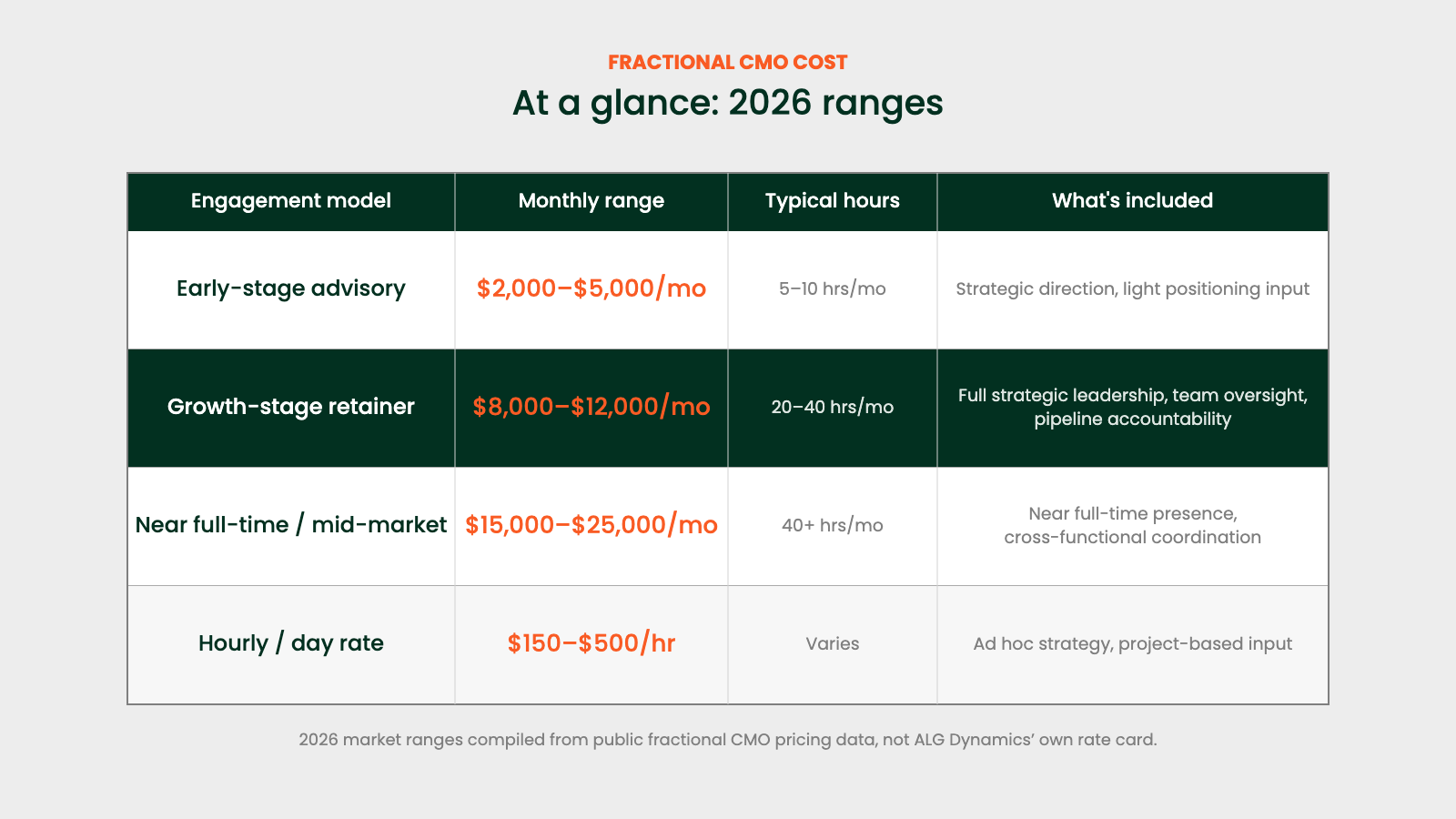
Fractional CMO Cost at a Glance (2026 Ranges)
| Engagement model | Monthly range | Typical hours | What’s included |
|---|---|---|---|
| Early-stage advisory | $2,000–$5,000/mo | 5–10 hrs/mo | Strategic direction, light positioning input |
| Growth-stage retainer | $8,000–$12,000/mo | 20–40 hrs/mo | Full strategic leadership, team oversight, pipeline accountability |
| Near full-time / mid-market | $15,000–$25,000/mo | 40+ hrs/mo | Near full-time presence, cross-functional coordination |
| Hourly / day rate | $150–$500/hr | Varies | Ad hoc strategy, project-based input |
These are 2026 market ranges compiled from public fractional CMO pricing data, not ALG Dynamics’ own rate card, and they vary by industry, seniority, and geography.
The Three Fractional CMO Pricing Models
Monthly retainer (most common)
The retainer model is the most common structure and the easiest to budget against. You pay a fixed monthly fee for an agreed number of hours or a defined scope, typically running three to six months minimum before either side evaluates whether to continue. Most experienced fractional CMOs default to this model because it aligns incentive with outcome rather than hours logged.
Hourly or day rate
Hourly and day-rate arrangements exist, usually for narrower advisory work rather than full strategic ownership. The problem with this model is structural, not personal. Billing by the hour rewards time spent, not results produced.
A retainer-based CMO has an incentive to solve your problem efficiently. An hourly one, even an honest one, does not carry the same built-in pressure to work fast.
Project or sprint-based
Project pricing covers a defined deliverable: a positioning overhaul, a go-to-market plan for a launch, priced as a fixed fee for a fixed scope. This model favors buyers who need a specific artifact rather than ongoing leadership, and it is the easiest to compare across vendors because the deliverable is spelled out in advance.
What Drives Fractional CMO Cost Up or Down
Seniority moves the number more than any other variable. A CMO with two prior exits or a decade in your specific industry commands more than someone earlier in their fractional career, and reasonably so. Industry complexity matters too. Regulated industries, complex B2B sales, and technical products all require domain fluency that takes time to build and gets priced accordingly.
Team size to manage changes the job itself. A fractional CMO overseeing a team of six contractors and employees is doing a different job than one advising a solo founder, and the rate reflects that. The number of channels in play, and whether the CMO is expected to build systems rather than simply advise on decisions someone else is already making, are the last variables that separate the bottom of the range from the top.
Geography still matters even for a role that works remotely. Rates benchmarked against San Francisco or New York run higher than the same experience level in the Midwest, and a company outside a coastal market can reasonably expect to pay less for comparable seniority without any drop in quality.
Fractional CMO Cost vs. Full-Time CMO: The Loaded Comparison
A full-time CMO’s real cost is never the number on the offer letter. Glassdoor’s 2026 data puts average CMO total compensation between roughly $237,000 and $440,000 a year, and once benefits, payroll taxes, bonus targets, and equity are counted, the loaded cost climbs further still. Add a recruiting fee and several months of ramp time before the hire is fully productive, plus severance risk if the hire does not work out, and the true first-year cost climbs again.
A fractional CMO at $8,000 to $12,000 a month runs $96,000 to $144,000 a year, roughly a third to half the loaded cost of a full-time hire, with no recruiting fee, no ramp time, and no severance exposure if the fit is wrong. That comparison is not an argument that fractional is always better. It is the honest number, not the LinkedIn number, and the number most full-time-hire advocates leave out.
The Hidden Costs Nobody Quotes
No fractional CMO pricing page mentions the tool stack you will still need to buy: the CRM, the analytics platform, the content and design tools the strategy depends on. None of that is included in the retainer, and it adds up fast for a company starting from nothing.
A fractional CMO also does not execute. Someone still has to run the ads, write the content, and build the pages the strategy calls for, which means budgeting separately for that execution capacity, whether that is a contractor, an agency, or an early hire. The cost of your own time in strategy meetings and review cycles is real too, even though nobody puts a dollar figure on it.
The strategy-shelf-life problem costs companies the most without them noticing. When a fractional CMO’s engagement ends, the systems they built need someone to maintain and evolve them. Companies that treat the engagement as a one-time fix, without planning for what happens after, often watch the positioning and pipeline discipline quietly decay within two quarters.
How to Tell If You’re Paying for Strategy or Just Hours
Ask what they would remove from your current marketing plan. A fractional CMO who is actually thinking strategically will have an answer, usually more than one, because strategy is as much about subtraction as addition. Someone billing hours rarely subtracts anything, because every removed task is revenue they are not collecting.
The second test is simpler. Ask for the specific deliverable list for the next 90 days. Vague answers about “alignment” and “positioning work” without a concrete artifact attached are a signal you are paying for a relationship, not a strategy.
Is a Fractional CMO Worth the Cost? The ROI Framing
The break-even math is simple enough to run in two minutes. Compare the monthly retainer against the revenue or cost savings the engagement needs to produce to justify itself, then compare that number against what a full-time hire, an agency, or doing nothing would cost across the same period. A $10,000 monthly retainer needs to influence only a small fraction of a typical deal size to pay for itself, which is a much lower bar than most founders assume before they run the actual numbers.
The honest answer is that a fractional CMO is worth the cost once the company is past the stage where the math would need optimistic assumptions to look good. If the number only works with a best-case scenario, the engagement is premature.
If the math works and you are ready to move, the retainer is only worth what it builds. Growth Architecture is the engagement itself: the positioning, pipeline, and system a fractional retainer is supposed to produce.
FAQs
How much does a fractional CMO cost per month?
Most engagements run $5,000 to $20,000 a month in 2026, with $8,000 to $12,000 the common range for a growth-stage company.
What is a typical fractional CMO hourly rate?
$150 to $500 an hour, with $200 to $250 common for CMOs with ten to fifteen years of experience and $300 to $500 for specialists with twenty or more.
Is a fractional CMO cheaper than a full-time CMO?
On loaded cost, materially. A full-time CMO’s total compensation often runs well over $250,000 a year once benefits and equity are counted, against $96,000 to $144,000 for a common fractional retainer.
How many hours per month do you get?
Most retainers include twenty to forty hours a month, though early-stage advisory arrangements can run as low as five to ten.
Are there hidden costs beyond the fractional CMO cost?
Yes. Tool stack, execution capacity, your own time in review cycles, and the strategy-shelf-life problem after the engagement ends. Ask about all four before signing.
The fractional CMO cost number was never the hard part. What it buys, and whether the company is at the stage where that purchase makes sense, is the actual decision.
Read the full in-house vs. fractional comparison if you are still weighing this against a full-time hire.