


Fractional CMO for Startups: When It Works, When It’s a Waste of Money
August 17, 2026
Fractional CMO Cost in 2026: Real Pricing, Hidden Fees, and What You Actually Get
August 21, 2026
B2B Fractional CMO: What They Do, What They Cost, and When You Need One
Your sales cycle runs nine months. The deal touches a champion, an economic buyer, a technical evaluator, and someone whose only job is to find a reason to say no. Marketing has been running campaigns built for a much simpler buyer, and the pipeline numbers show it.
A B2B fractional Chief Marketing Officer (CMO) is a senior marketing leader engaged part time to build the positioning, pipeline architecture, and sales alignment a complex buying process actually requires, without the cost of a full-time executive. The role only works when the person doing it has run B2B before. A generalist fractional CMO trained on consumer or short-cycle SaaS will optimize the wrong variables for a nine-month committee sale.
What Makes a B2B Fractional CMO Different (and Why a Generalist Fails Here)
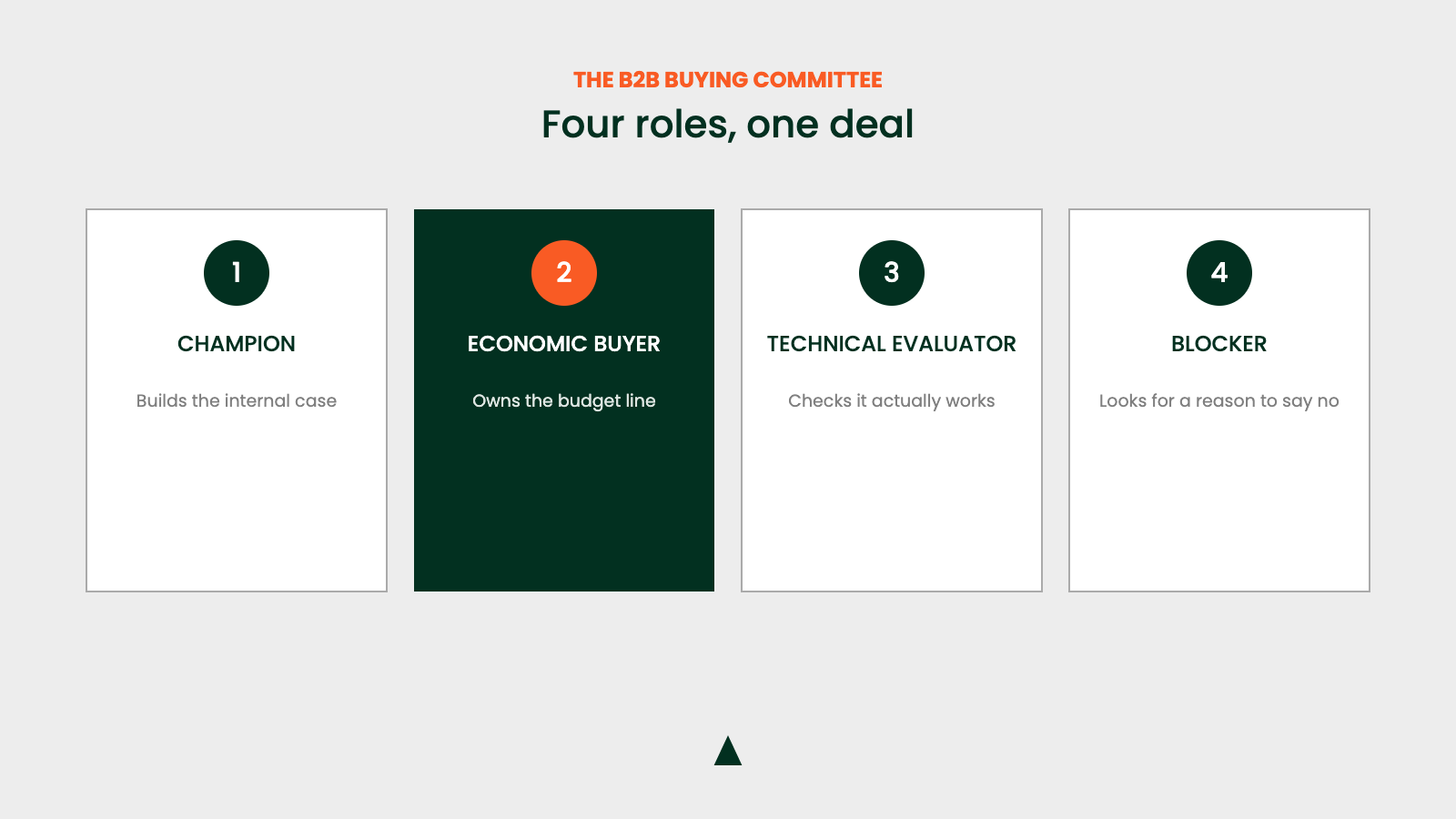
B2B buying decisions move through committees, not individuals. A single deal can touch four or five people with different priorities: the champion who wants to look good for pushing this forward, the economic buyer who owns the budget line, the technical evaluator checking whether the product actually works as claimed, and someone whose job, formally or not, is risk mitigation. Gartner’s research puts the average B2B buying group at around 11 stakeholders for technology purchases, each of whom needs different proof before they will move.
Cycles run six to eighteen months, sometimes longer for enterprise deals. Most of that activity happens in what practitioners call the dark funnel: research, internal conversation, and vendor comparison that never touches a form fill or a tracked page view. A CMO trained on B2C or short-cycle SaaS will optimize for the metrics that are visible, top-of-funnel traffic and lead volume, while missing the committee dynamics that actually determine whether the deal closes.
Marketing and sales are also structurally dependent on each other in B2B in a way that does not exist in most consumer businesses. A campaign that generates leads sales cannot use is not a campaign that worked. A B2B fractional CMO has to own that dependency directly, not treat it as someone else’s problem.
What a B2B Fractional CMO Actually Owns
Positioning against alternatives (including “do nothing”)
B2B positioning has to answer a harder question than “why us instead of a competitor.” Most complex B2B purchases compete against inaction. The real alternative to your product, for a meaningful share of prospects, is doing nothing and living with the current problem. Positioning that only differentiates against named competitors misses the actual decision being made.
ICP and trigger-based targeting
An effective B2B ideal customer profile (ICP) is not a firmographic profile. It is a firmographic profile plus a trigger: the specific event or condition that makes a company ready to buy now instead of eventually. Without the trigger, targeting produces a list of companies that could theoretically be customers someday, which is not the same as a list worth spending budget against this quarter.
Pipeline architecture: stages, definitions, conversion targets
Pipeline stages need hard definitions, not vibes. What specifically moves a deal from marketing qualified to sales qualified. What conversion rate between stages is realistic for this business, based on actual historical data rather than a generic SaaS benchmark. A B2B fractional CMO builds this architecture once and hands sales a shared definition everyone actually uses.
Sales and marketing alignment: the handoff contract
The handoff between marketing and sales is where most B2B pipeline quietly dies. A defined handoff contract states exactly what marketing delivers before a lead counts as qualified, what sales commits to doing with it, and how fast. Without that contract in writing, both teams blame each other for the same broken number.
Content coverage across the buying committee
Most B2B content speaks only to the champion, the person most likely to be reading a blog post at 9pm trying to build a business case. The economic buyer needs a different argument. The technical evaluator needs a different one still. A B2B fractional CMO maps content coverage against every seat at the table, not just the one most likely to click.
The measurement model that survives long cycles
Standard marketing attribution breaks down when the sales cycle outlasts a fiscal quarter. A measurement model built for B2B has to track leading indicators: engagement depth across multiple buying-committee members, and content consumption patterns that historically precede a deal moving forward, so it can predict pipeline before pipeline shows up in a report.
The First 90 Days in a B2B Fractional CMO Engagement
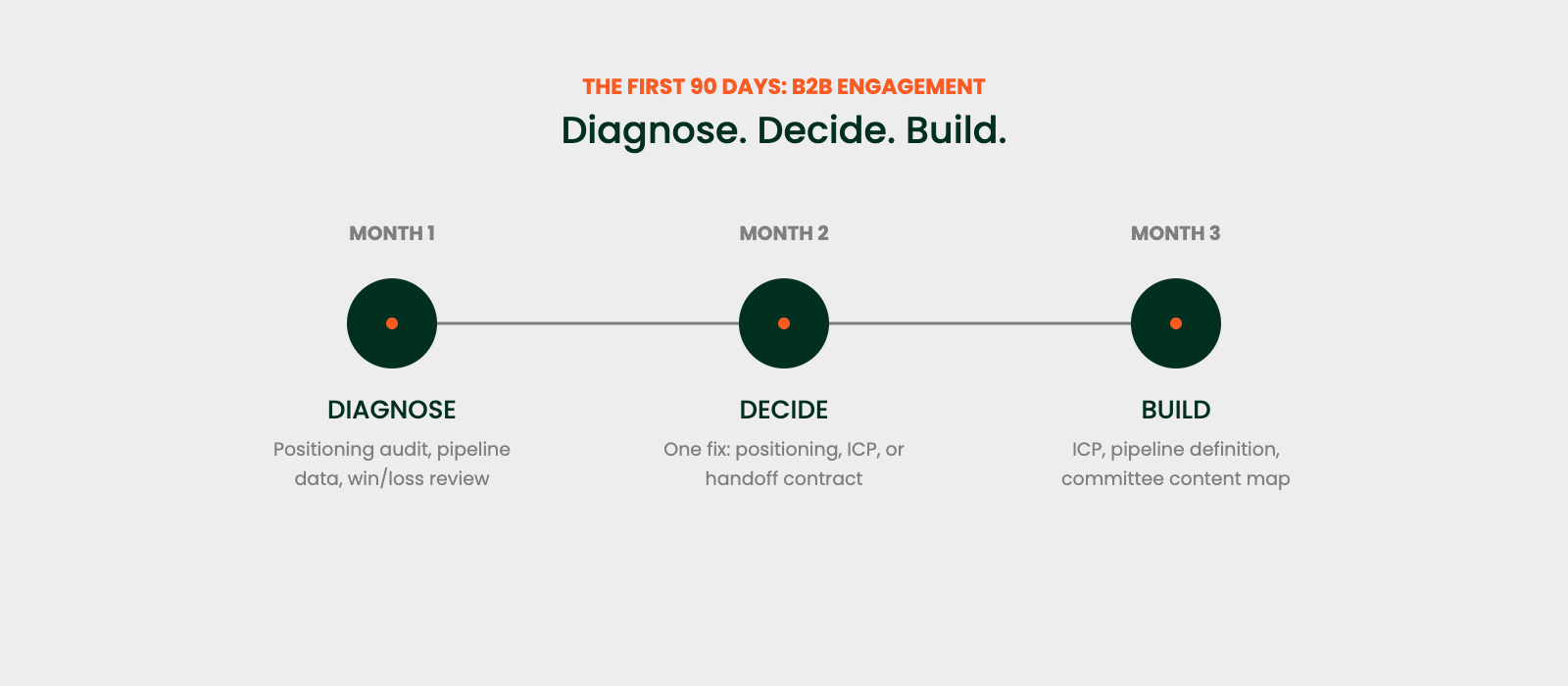
The sequence mirrors any serious diagnostic engagement: diagnose, decide, build. The first month audits current positioning against what the buying committee actually needs to hear, reviews whatever pipeline data exists, and interviews recent wins and losses to find the pattern sales already knows but has never documented.
The second month narrows to the highest-impact fix: usually positioning, ICP definition, or the handoff contract, rarely all three at once. The third month builds the system: a documented ICP with triggers, a pipeline definition sales has actually agreed to, and content mapped to at least two buying-committee roles beyond the champion.
Demand these three things by day 90. If the engagement produced meetings and a deck instead, it did not do the job.
The Buying-Committee Content Map
This is the piece almost no B2B fractional CMO content addresses directly, and it is worth naming because it is the actual mechanism that makes B2B marketing different from every other kind. Every deal has a champion, an economic buyer, a technical evaluator, and a blocker, whether or not the org chart labels them that way.
The champion needs help building an internal business case. The economic buyer needs risk reduction and a clear cost of inaction. The technical evaluator needs proof the product performs as claimed, usually in a format more rigorous than a case study. The blocker needs a reason not to escalate the deal to someone above them.
We build content coverage against all four roles, not just the champion, because a deal that stalls with an unconvinced technical evaluator or an unaddressed blocker is a deal marketing helped lose, even if the champion was fully sold. The real job of B2B marketing is making it safe for the champion to advocate internally. Everything else is in service of that.
Measuring a B2B Fractional CMO When the Cycle Outlasts the Contract
Here is the honest problem nobody addresses directly: a six-month fractional engagement inside a twelve-month sales cycle means the CMO may be gone before a single influenced deal closes. That does not make the engagement worthless. It means the measurement has to shift to leading indicators that reliably predict pipeline before pipeline shows up.
Track engagement depth across multiple committee roles, not just the champion. Track content consumption patterns that historically precede a deal advancing a stage. Track whether sales conversations are using the positioning marketing built, or reverting to whatever each rep improvised before. Those three signals move faster than closed revenue and correlate with it closely enough to serve as a fair scorecard for a fractional engagement that will not outlast the sales cycle it is trying to improve.
B2B Fractional CMO vs. Agency vs. In-House VP
A B2B fractional CMO sets direction: positioning, ICP, pipeline architecture, the handoff contract. An agency executes against direction that already exists, running the campaigns, building the content, managing the channels once someone has decided what the strategy actually is. Hiring an agency before the direction exists is the most common expensive mistake in B2B marketing, because the agency will execute confidently against a strategy nobody actually validated.
An in-house VP of Marketing makes sense once the company needs daily operational ownership: a growing team, tight coordination with product and sales leadership, execution as well as direction. A B2B fractional CMO makes sense when the company needs the direction-setting work done well before it can justify, or fill, that full-time seat.
The three options are not mutually exclusive over time. Many B2B companies run a fractional CMO first to build the architecture, bring in an agency to execute against it once the direction is set, and hire a full-time VP once the pipeline and team are large enough to need daily ownership. The mistake is skipping straight to execution, whether that execution comes from an agency or a new hire, before anyone has done the direction-setting work.
If your pipeline needs that direction-setting work before anything else, that is what we build. Growth Architecture is ALG Dynamics’ engagement for exactly this: positioning, pipeline architecture, and the sales alignment this section just walked through.
B2B Fractional CMO Cost and Engagement Models
B2B fractional CMO retainers typically run $8,000 to $20,000 a month, tracking toward the higher end for engagements requiring near full-time hours or specialized industry experience. Hourly and day-rate arrangements exist but tend to favor the seller over the buyer, since billing by the hour has no built-in incentive to work efficiently.
Most serious B2B engagements run a minimum of six months, because pipeline architecture and positioning changes need at least two quarters to show real conversion movement in a long sales cycle. Regulated industries, complex technical products, and enterprise sales motions with multiple stakeholders all push the rate toward the top of the range, since the domain fluency required takes longer to build and shows up in every deliverable from the ICP definition to the buying-committee content map.
For the full breakdown of pricing models and hidden fees, see fractional CMO cost.
FAQs
What does a B2B fractional CMO do?
Owns positioning, ICP, pipeline architecture, and sales alignment. Does not run campaign execution day to day.
How much does a B2B fractional CMO cost?
Typically $8,000 to $20,000 a month, depending on hours and industry complexity.
How is a B2B fractional CMO different from B2C?
Committees and cycle length change nearly every decision, from what content gets built to how success gets measured.
How long should a B2B fractional CMO engagement last?
Six to twelve months minimum, since pipeline effects in a long sales cycle take that long to show up clearly.
Can a fractional CMO fix a sales problem?
Only the part that is actually a marketing problem, like unclear positioning or a broken handoff. A sales team that cannot execute a good process is a different problem entirely.
A B2B marketing audit is the right starting point if you are not yet sure whether the gap in your pipeline is a positioning problem, a sales execution problem, or something further upstream. Most B2B companies find it is more than one.